
Exhibits of the Survived History
Hall of the Survivors
Everything else has been buried under layers of earth, burned, crumbled, melted down into bullets, sold off piece by piece, or simply forgotten. Cities have become pits. Gods have turned to dust beneath tourists’ feet. Empires left behind nothing but clay tax records. Yet these ten objects stand. Under cold light. Behind glass. In the Antalya Archaeological Museum. They are not the loudest. Not the most beautiful. These exhibits are simply the ones that refused to be erased.
We did not come here for beauty. We came to check what remains after the system crash. Because civilization is not buildings. It is not statues. It is a glitch in the matrix that, for some reason, was never patched. These ten fragments are proof. They survived. Everything else—no.
Inventory of the Survived
1. Statue of the Dancer in the Void
2nd century CE, Perge. 103 fragments reassembled. White marble for skin, black for hair and clothing. A woman (or a maenad of Dionysus) spins in a motion that no longer exists. The body is almost absent, but the rhythm remains. She dances in the void between worlds. Stare long enough and it feels like she turns her back to you, though she stands motionless. This is not a statue. It is a glitch in the program of reality. Motion that outlived the end of the dance.
2. Bronze Statue of Lucius Verus
161–169 CE. Full-size bronze. One of the few that did not become cannon fodder. Stolen from Bubon in the 1960s, lived with collectors in the US, returned in 2022 after decades of negotiations, expert examinations, and measuring footprints on the pedestal. The emperor who ruled alongside Marcus Aurelius and died of plague. Now he gazes at us with empty bronze eyes and is silent. Bronze that refused to die twice.
3. Statue of Heracles (Yorgun Herkül)
Roman copy after Lysippos. Found in Perge. Upper half of this exhibit in Boston for 30 years. Lower half in the ground. Reunited 2011–2014. The weary hero leans on his club, apples of the Hesperides behind his back. He completed all 12 labors and still stands. He did not win. He simply did not disappear. Every muscle remembers the weight of the world. The most honest Heracles we know: even immortals grow tired.
4. Mosaics from Seleukeia Lyrbe
Roman-Byzantine floor mosaics, 2nd–5th centuries CE, from the ancient city of Seleukeia Lyrbe (Pamphylia, near Manavgat). Not just geometry—a whole library underfoot. Strict meanders, rhombi, waves, circles inscribed with squares—pure mathematical order that survived chaos. And suddenly—portraits of philosophers in the border: Solon, Lycurgus, Euclid, Aristotle, Plato, labeled in Greek letters. The faces of the wise look upward, as if checking whether anyone has forgotten their names. Nearby—hunting scenes, birds in medallions, fish, dolphins, grapevines intertwined with geometry. All of this once floored a wealthy villa or public building. When you step on them in the museum hall, it feels like treading on someone else’s memory. The mosaics do not shout. They whisper: “We were here. We thought. We gazed at the stars. And now we gaze at you.” These exhibits are not decoration. This is a backup copy of the mind that the earth refused to delete.
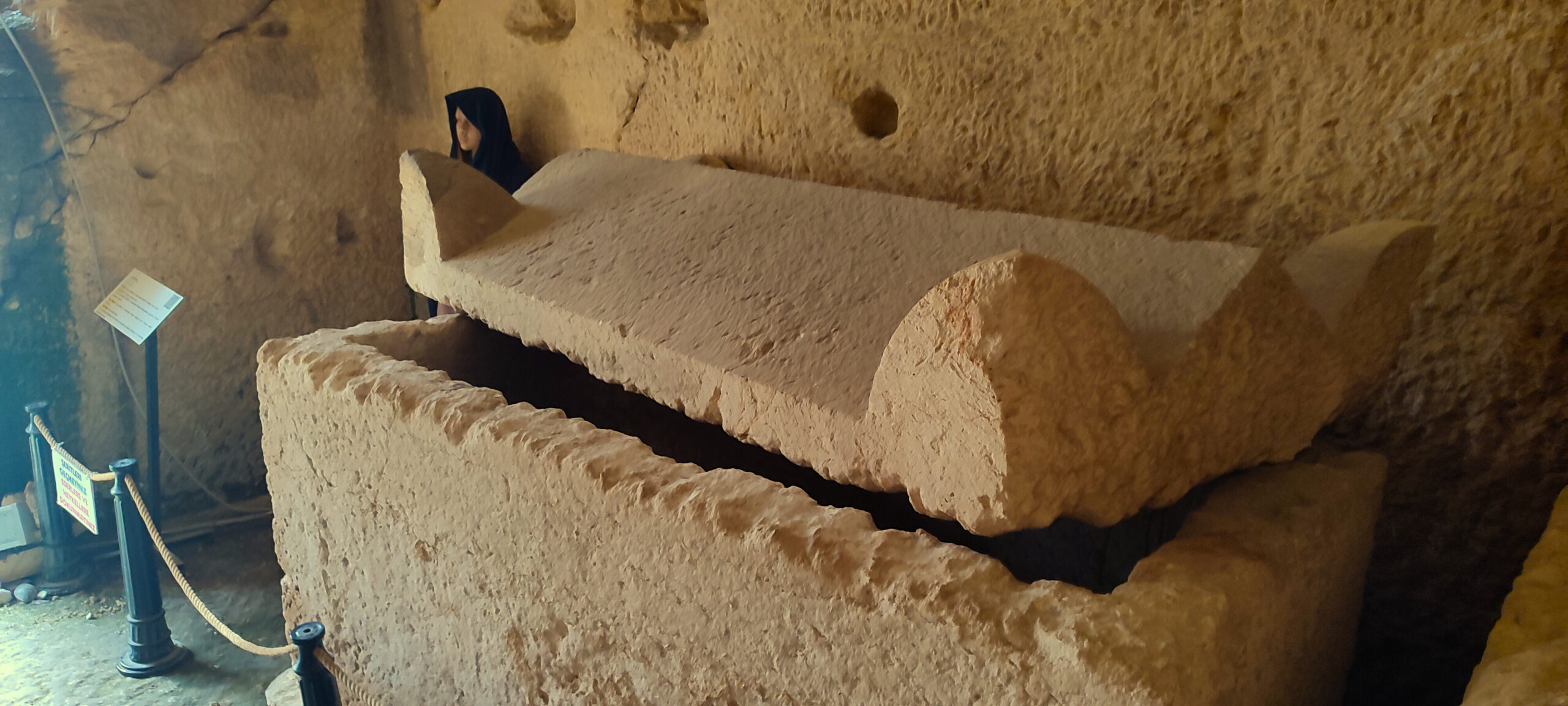
5. Heracles Sarcophagus
2nd–3rd century CE. Perge. The best-preserved of the four known in the world. The 12 labors circle like an eternal loop. Stolen from the East Necropolis in the 1960s–70s, returned from a private collection. Heracles kills, cleanses, steals again and again. Even in death he works. The stone remembers every drop of sweat. This is not a coffin. This is proof that labors never end.
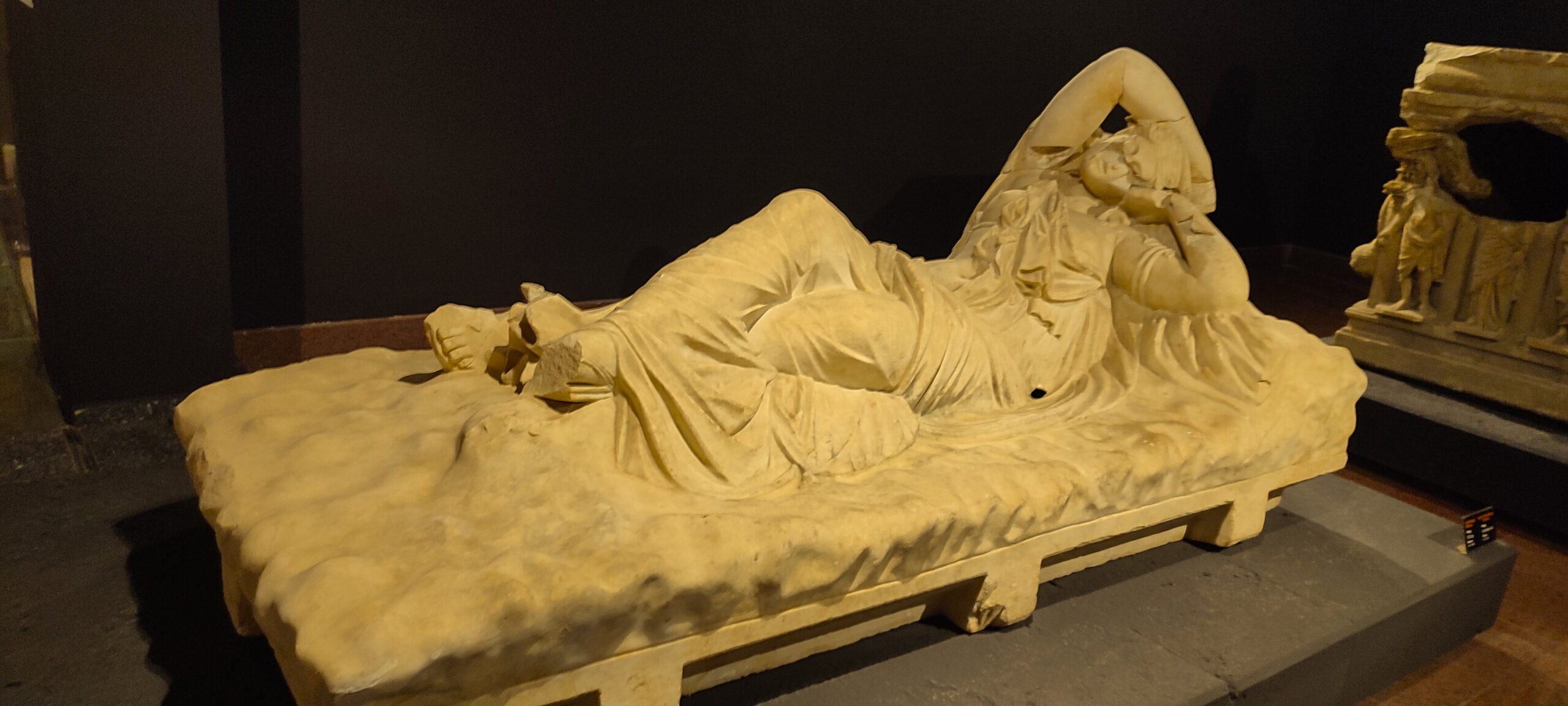
6. Ariadne Sarcophagus (lid only)
2nd century CE. Perge. Sleeping Ariadne on the rock. Hand behind her head. Dionysus has not yet arrived. Theseus has already sailed away. She sleeps between betrayal and salvation. The quietest and loudest figure in the museum. The marble is so thin it seems—if you blew on it—she would wake. But she will never wake. This is a dream that outlived the myth.
7. Statue of the Three Graces
Perge, 2nd century CE. Three girls embrace each other. Aglaea, Euphrosyne, Thalia. Beauty, joy, creativity. They need no viewer. They are self-sufficient. When you look at them, you understand: true beauty is always triple. One cannot survive. Two will quarrel. Three are eternal.
8. Gladiator Relief Tablet
2nd–3rd century CE, Aspendos or Pamphylian region. Marble slab-relief: a gladiator in full stance, shield in one hand, short sword in the other, crested helmet, muscles tensed, poised for the strike. Sometimes a second fighter nearby—retiarius with net and trident. This is not just a picture. It is a frozen moment when the crowd roared and life hung on the tip of a blade. Such tablets hung in theaters or on gladiators’ tombstones—like a posthumous billboard: “I fought. I survived. Or I didn’t.” The stone remembers the screams that long fell silent, and the blood that dried two thousand years ago. In the hall among statues of gods and emperors, this small tablet stands as a reminder: civilization loved watching people kill each other for applause. And this relief outlived the arena, outlived the empire, outlived oblivion. Now it looks at us—and waits for us to look away.
9. Sarcophagus for a Dog (Köpek Lahdi / Sarcophagus of Stephanos)
3rd century CE, found near Termessos. Limestone, shaped like a small temple or doghouse with a gabled roof decorated as an ancient pediment. Greek inscription: “This is the tomb of the dog Stephanos who perished. Rhodope shed tears for him and buried him like a human. I am the dog Stephanos, and Rhodope set up this tomb for me.” Stephanos was not just a dog. He was family. His owner, Rhodope—a wealthy, possibly single woman from Termessos—gave him a real sarcophagus with a human epitaph. In the Sarcophagus Hall, among giant coffins of emperors and heroes, stands this tiny one—dog-sized. The stone remembers the bark that long fell silent. This is not a curiosity. This is proof that love for animals is older than we think. Civilization buried not only gods and warriors—it buried friends. And this small coffin survived centuries, wars, oblivion. Stephanos is still here. Sleeping in his temple.
10. Urn-Cup from the Burial at Karataş-Semayük
Early Bronze Age, ca. 2000–1500 BCE, Elmalı. Large clay vessel containing cremated bones. The exhibit is the small cups beside it. Someone once placed a person inside, sealed the lid, and said: “Enough.” And it worked for five thousand years. The first known backup of a soul.
Wear of Memory
The Dancer is missing fingers. Lucius Verus bears traces of modern glue. Sarcophagi cracked along seams. Mosaics lost half their color. Tourists breathe on the glass. Flash photographs. Restorers paint, polish, level. The museum pretends to save. In reality—it only slows. Time takes its toll anyway. Slowly. Inexorably. As always.
Shadows on the Edge of Reason
Why these?
Why not thousands of other statues turned to lime?
Why not all mosaics crushed by bulldozers?
Because someone decided to steal them.
Because someone decided to return them.
Because dry Anatolian soil is better than any preservative.
Because money arrived on time.
Because an archaeologist dug in the right place.
Because a thief regretted melting the bronze.
What survives is not the most valuable. Exhibits what survives is what someone needed. The rest is noise.
How to See It Now
Antalya Archaeological Museum. City center, Antalya. Open daily except Monday. Ticket—laughably cheap.
Go straight to the Perge Hall—many exhibits are there. Mosaics in a separate hall. Prehistory exhibit near the entrance. The dog sarcophagus (and other sacrcofagus exhibits) in the Sarcophagus Hall, among giants it looks like a reminder: even small lives leave traces.
Do not rush. Stand. Look. Touch the glass (you cannot, but you want to). What exists today may vanish tomorrow. Earthquake. New thief. New war. New fashion. Nothing is guaranteed.
Echo of the Showcase
You stand and realize: you too are a temporary exhibit.
These things have already outlived everything we are yet to lose.
They are not about beauty.
They are about the stubbornness of matter.
About how a piece of stone or bronze can be more stubborn than an entire civilization.
About how, even when everything ends—something will remain and watch the next ones.
And these exhibits stay silent.
#VoiceOfRuins #HallOfSurvivors #TheySurvived #AntalyaMuseum #Pamphylia #SurvivingFragments #ArchiveOfTheEnd #ShowcaseOfCivilization #Exhibits


Our Telegram-channel: Voice Of Ruins https://t.me/Voice_Of_Ruins
Our Instagram: Voice Of Ruins https://www.instagram.com/voiceofruins/
Our group on Facebook: Voice Of Ruins https://www.facebook.com/share/g/16aitn9utM/
Our site: Voice Of Ruins https://www.voiceofruins.org



Leave a Reply