
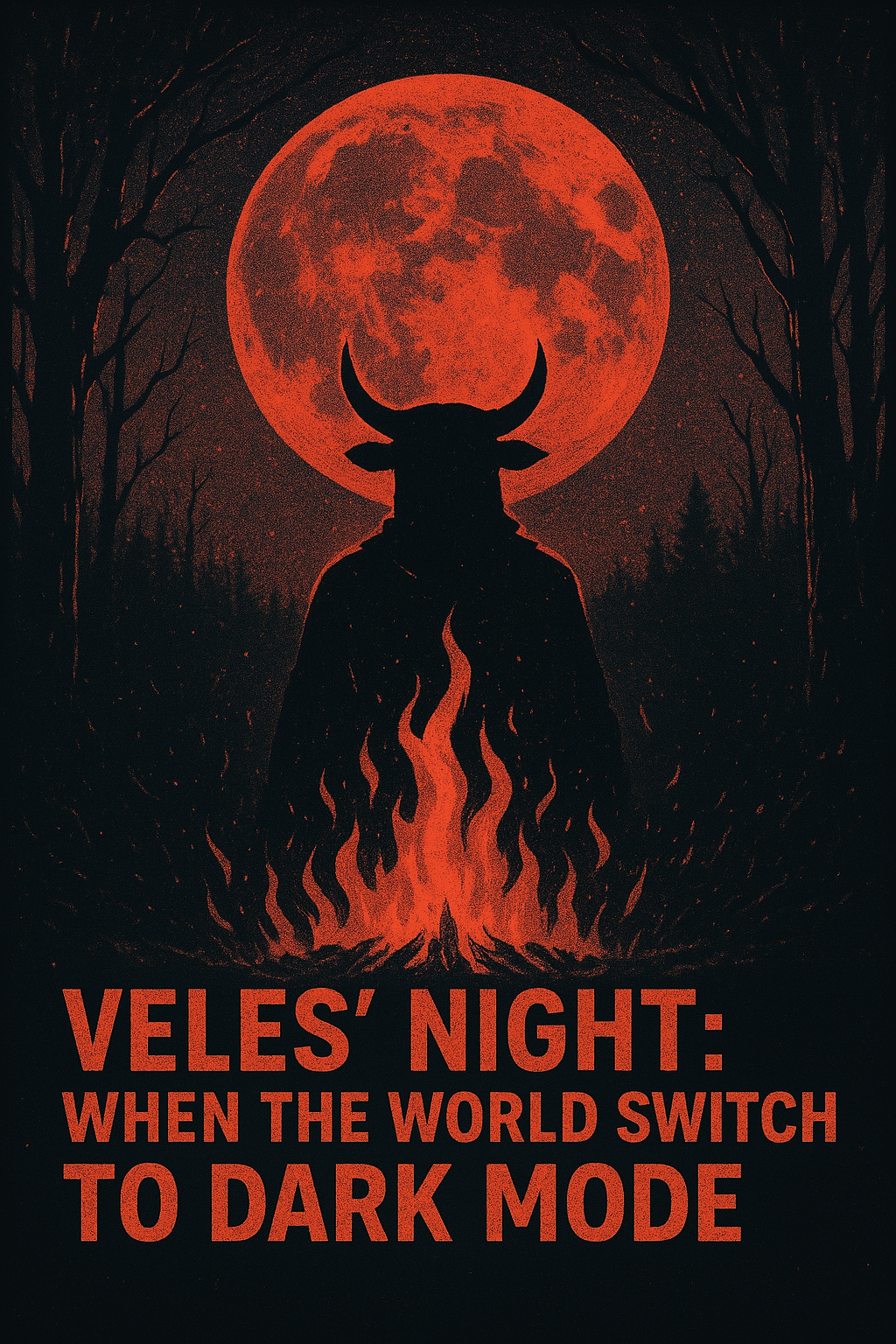
Calendar of Oblivion
Gates of Time
There are days when the world grows tired of its own light. When the sun is not a god, but a bug. A glitch in the system.
When night doesn’t just fall — it restores access rights to those pushed to the periphery of human attention.
That is Veles’ Night — an ancient passage between worlds. The threshold between autumn and winter, when boundaries blur, and the air smells not of leaves, but of the code of decay.
Veles, god of darkness, wisdom, and underground exchange, rises from the shadows to remind us: everything you call “reality” is just a temporary build.
Once, on this night, fires were extinguished and new ones lit — to bring warmth back from the underworld.
Today we just turn off our screens and call it rest. But the essence remains the same: the world switches to dark mode — so it doesn’t have to see itself.
Feast Beyond the Black Veil
They celebrated with meat and fear. The feast began at the fires: people donned animal hides so Veles wouldn’t recognize them — or so that he would.
Clay masks, soot, ale, bull’s blood, sacrificial porridge. None of it was about food — it was about connection.
They danced to keep the earth from freezing, ate to feed the gods, drank to dissolve the border between the living and the dead.
Veles’ Night isn’t a holiday. It’s a protocol update between realities. Every flame is a portal. Every song — a system error. Every mask — a temporary identity. And while you spin around the fire, something from the depths returns — to remember you.
Gods Among Us
Veles is not just the god of the underworld. He’s the administrator of the universe’s shadow sector. Patron of cattle, magic, trade, and deceit. The one who leads souls along the path between forest and sky.
If Perun is the vertical bolt of lightning, then Veles is the horizontal maze. On this night, he rises to the surface — not to punish, but to rebalance. He is the glitch without which the system would freeze.
Veles reminds us: chaos is also order — just with a different interface.
Shadows on the Edge of Mind
Festivals like this are mirrors. They don’t reflect the past — they show what we repress. We dress as beasts because we fear being them. We light fires so we don’t feel the cold within. We celebrate death to believe that we are alive.
Rituals exist where logic dies. A feast is a crutch for consciousness. Veles’ Night is that moment when the collective unconscious reboots — and for a split second, sees its own code.
How We Got Here
It was celebrated at the edge of October and November — when the fields were already dead, but winter hadn’t yet arrived.
Among the northern Slavs, it was the night before the Day of the Ancestors, when the souls of the dead came to the fire.
Today — reconstructions, festivals, masked sabbaths. Sometimes there’s electronic music, mead brewing, ritual texts read over a beat.
In Poland and the Czech lands — similar rites. In the Baltics — Velnas’ Day. In Ireland — Samhain. All about the same thing: memory that never dies, just goes dormant.
And if you stand by a 21st-century bonfire, phone in hand instead of a torch — know this: you’re continuing the same tradition. Only now, the sacrifices are your data.
Echo in the Void
I stood by the fire. People around me wore masks — yet, for the first time in ages, seemed to be themselves. The air smelled of smoke and digital sweat. Someone drank from a horn. Someone prayed. Someone simply stared into the fire — like into an ancient screen.
And I understood: Veles’ Night isn’t about gods. It’s about rebooting. About the right to be a beast, a spirit, a shadow — anything, until the light returns.
The world truly switched to dark mode. And in that darkness — for the first time — we became visible.


English Group: Voice Of Ruins https://www.facebook.com/share/g/16aitn9utM/
Наш инстаграм: Voice Of Ruins https://www.instagram.com/voiceofruins/
Наш телеграм-канал: Голос Руин https://t.me/Golos_Ruin
Наш сайт: Voice Of Ruins https://www.voiceofruins.org



Leave a Reply