
The Mystical Protocol and the First Assembly of Reality
Vanishing Point
There are places where emptiness is not just around you — it’s under your skin. Gobekli Tepe is one of them. You climb the hill and feel that the wind here is older than civilization. It doesn’t blow — it remembers.
Gravel crunches somewhere beneath your feet, the only sound that acknowledges your existence. Everything else seems to be waiting for you to dissolve. As if the place itself is quietly rebooting your “self” to factory settings.
Emptiness here is not an absence. It is a function embedded in the early architecture of the world.
And if you listen closely, you can hear the pause between breaths turning into the first line of some ancient, incredibly important instruction.
Landscapes Without Hope
The road to Gobekli Tepe is not difficult, yet strangely colorless. Wide fields torn by wind, stones that look like unfinished thoughts. Cars move slower here than they should — as if space itself is learning to resist technology.
At the approach stands a modern museum — glass, wide galleries. But step onto the open platform, walk along the wooden paths, and suddenly the world splits again into “before” and “after.” As if the walls of civilization have been switched off, leaving only fragments of reality’s operating system.
The first circles appear immediately. They are not massive — but they are clearly not from here. Not by time. Not by logic. Not by the scale of the idea.
The Cry of Stones
The stones of Gobekli Tepe do not fall silent. They remember.
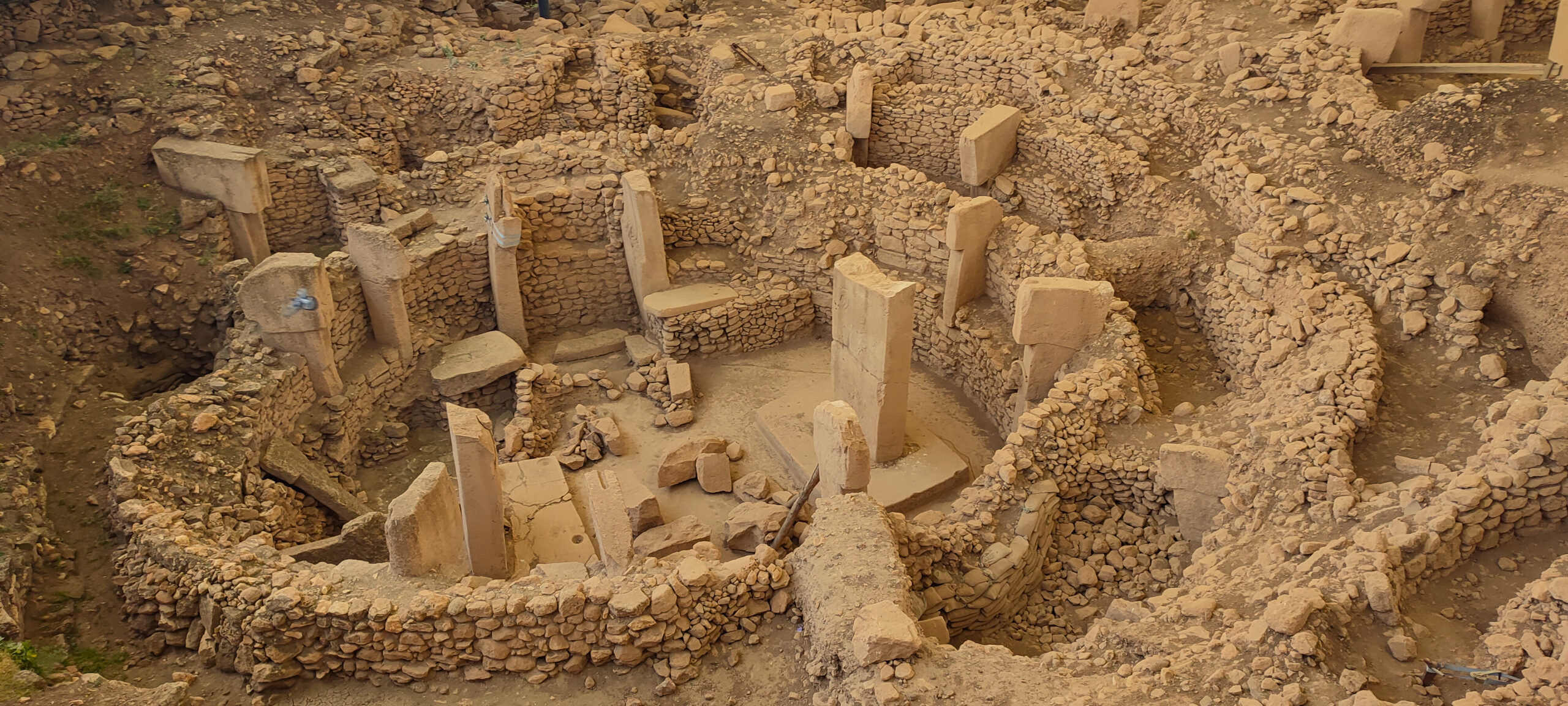
The T-shaped pillars — reaching up to six meters in height — resemble anthropomorphic figures frozen in ritual anticipation. On some, hands, a belly, a belt are carved. No faces — that would have been too human. Here, they chose to begin with larger entities.
Carved on the columns are animals long gone: foxes, badgers, boars, spiders, snakes. But what matters most is the order. They are arranged not like decorative chaos, but like a code — ancient and rigid, an instruction manual for launching the universe.
And at some point, you realize: these pillars didn’t simply stand at the center of ritual circles. They were the circles. Meanings. Servers of collective consciousness before humans ever invented writing.
You stand in the middle of the platform, and it seems the stones are looking somewhere above you — toward the point where, according to archaeologists, a roof once rose.
But the feeling is different: as if they are looking through time.
Shadows on the Edge of the Mind
A historical fact: Göbekli Tepe is the oldest known cultic structure in the world, dated to approximately 9600–8200 BCE.
But facts don’t explain sensations.
The reconstruction goes like this: tribes of hunter-gatherers came here as a single flow, coordinating the efforts of tens of thousands of people. This is not a “village.” Not a “temple.” It is humanity’s first server, where Neolithic updates were being uploaded.
People gathered here not for prayer — gods had not yet been invented. Not for trade — there was nothing to trade yet. And certainly not for power — no one had learned how to package it.
They came to synchronize fears, to discuss the shadows that followed them through the darkness. So that structure could emerge from chaos. Symbol from fear. Ritual from symbol. Civilization from ritual.
And then — another strange fact: people themselves buried the complex, carefully, gently, as if hiding it until the time when we would finally learn how to ask the right questions.
Those who hide things are planning a return.
Footprints on the Map
Getting here is easy: 20–25 minutes by car from Şanlıurfa. Taxi, bus, or transfer from the museum center.
It’s best to arrive at opening time or after 4 p.m. — the sun is less brutal, there are fewer visitors, the silence grows denser.
There are walkways, information panels, a museum with reconstructions, a café. But all of this is only a shell — designed so you won’t fully feel how little this place still fits into the map of familiar reality.
The main thing is to stop, put your phone away, let the wind pass through your head. It knows the route better than any guide.
Echo in the Void
When you leave, there’s a feeling that you’ve torn something invisible. A connection. A channel. A ritual you took part in without fully realizing it.
Gobekli Tepe is not just archaeology. It is the place where the world remembered that it exists. And if you stare at the stones long enough, there’s a sense that you, too, begin to remember.
But remembering for too long isn’t allowed — this place doesn’t like long-term memory. It’s about the moment. About that first instant when a human looked into the void and said, “I am here.”
And the void replied: “Go and build.”


Our Telegram-channel: Voice Of Ruins https://t.me/Voice_Of_Ruins
Our Instagram: Voice Of Ruins https://www.instagram.com/voiceofruins/
Our group on Facebook: Voice Of Ruins https://www.facebook.com/share/g/16aitn9utM/
Our site: Voice Of Ruins https://www.voiceofruins.org



Leave a Reply