
The Call of Emptiness
Point of Disappearance
The Ihlara Valley is not an anomaly or a miracle. It is the result of a very specific, almost cold chain of events stretched across hundreds of thousands of years.
The canyon was formed by the Melendiz River, which slowly and methodically cut into volcanic tuff ejected by ancient eruptions of Mount Hasan and Mount Erciyes. The water was in no hurry. It had enough time — more time than any civilization.
When you enter Ihlara, disappearance happens not mystically, but physiologically:
noise levels drop, vision stops clinging to distant horizons, attention contracts. Space objectively restricts you — and the brain switches to a different mode.
Emptiness here is not a symbol. It is an environmental effect.
Landscapes Without Hope
The canyon stretches for about 14 kilometers, and in some places reaches depths of up to 100 meters. The walls are nearly vertical — a typical erosion profile of tuff: soft, yet stable, ideal for washing away and carving.
That is why Ihlara looks “inconvenient” for humans.That is exactly how it was designed — not by people, but by geology.
Vegetation concentrates along the river: willows, poplars, shrubs forming a local microclimate. Temperatures at the canyon floor are often several degrees lower than on the plateau above — in summer this feels almost like a technological solution.
Above you — dry Cappadocia. Below — a moist, green strip of life.
The contrast is not poetic. It is climatic.
The Cry of Stone
What feels like a “hum” or “breathing” has a simple explanation: the narrow profile of the canyon amplifies and modifies sound. Wind, water, footsteps — everything reflects off the walls, creating low-frequency vibrations.
Tuff is porous. It does not reflect sound like granite or basalt. It absorbs it, leaving a strange sense of muffling — as if the world is running with noise cancellation enabled.
The stones are “silent” not because they hide a secret, but because the material absorbs excess information.
And yet the brain, deprived of familiar reference points, fills in the gaps. This is how perception works: when data is scarce, imagination takes the initiative.
Shadows at the Edge of the Mind
Most of Ihlara’s effect is neurobiology.
— Limited field of vision
— Monotonous relief
— Repetitive sound of water
— Absence of urban signals
These are classic conditions for entering a state of mild sensory deprivation. Thoughts slow down. The inner dialogue grows louder.
That is why people tend to describe Ihlara as “a place where you think.” Not because it communicates something, but because it stops interfering.
The mysticism here is created not by the valley, but by the human left alone with their own cognitive patterns.
Traces on the Map
— Location: Aksaray Province, Cappadocia
— Route length: ~14 km
— Elevation difference: up to 100 m
— River: Melendiz (permanent water flow)
— Over 100 rock-cut churches and monastic spaces
— Main period of use: 4th–13th centuries
— Function: shelters, monasteries, settlements, religious complexes
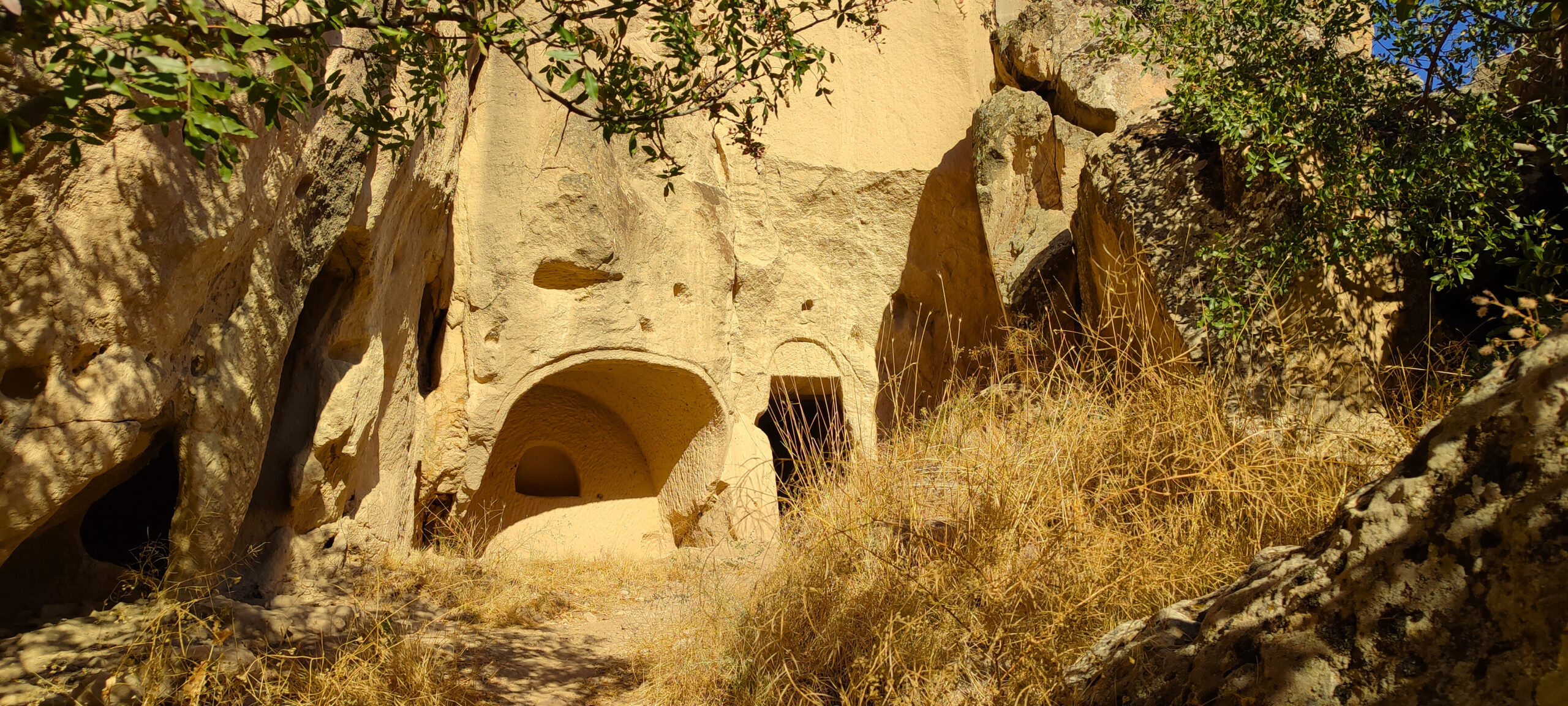
The cave churches are not “secret temples,” but a rational response to the environment: tuff is easy to carve, retains temperature, and protects from external threats.
Most frescoes were lost not to time, but to moisture, smoke, and human presence.
Echo in the Emptiness
Ihlara leaves an impression not because it is special, but because it is honest.
It shows how little is needed for a person to start hearing themselves: remove excess stimuli, limit space, let water do its work.
This is not a place of power. It is a place of conditions.
You leave the canyon with the feeling that nothing happened — and that is precisely why something changed.
#VoiceOfRuins #DustOfTime #Ihlara #Cappadocia #Geology #Science #Canyons #MelendizRiver #CaveChurches #Erosion #Landscape #HumanAndEnvironment


Our Telegram-channel: Voice Of Ruins https://t.me/Voice_Of_Ruins
Our Instagram: Voice Of Ruins https://www.instagram.com/voiceofruins/
Our group on Facebook: Voice Of Ruins https://www.facebook.com/share/g/16aitn9utM/
Our site: Voice Of Ruins https://www.voiceofruins.org



Leave a Reply