
Taste of Decay
Food Chains of Empires
There is food that appears together with states, and food that outlives them without commentary. Gozleme belongs to the second category.
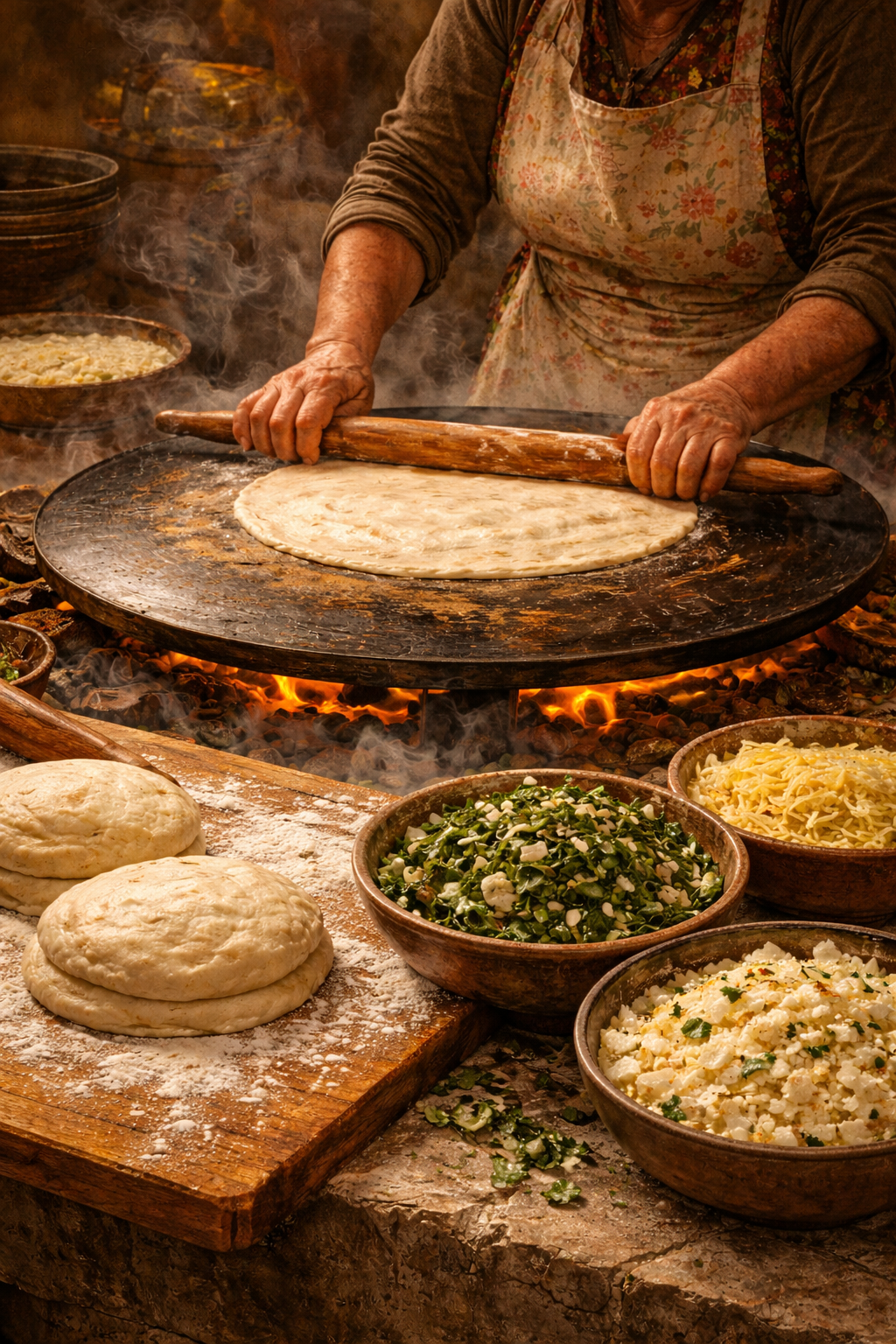
This flatbread existed long before anyone decided to call themselves an empire. Before taxes, before armies, before coats of arms and coins. When Hittites, Phrygians, Greeks, Romans, Byzantines, Seljuks, and everyone else who considered themselves temporarily eternal crossed Anatolia, gözleme was already lying on hot metal, sizzling, and uninterested in politics.
Empires build verticals. Gozleme is horizontal.
Thin dough, simple filling, heat — this is not the cuisine of victors. It is the food of those who do not count on tomorrow but know for certain that today they have to eat. Preferably fast. Preferably from whatever is at hand.
On the Teeth of Civilization
Gozleme does not impress with flavor. It doesn’t try to.
Cheese, herbs, potatoes, sometimes minced meat — everything is brutally honest, almost ascetic. The taste does not explode, does not unfold in layers, does not demand descriptions. It simply exists.
You take a bite and understand: this is food that does not distract from life. It does not ask for attention. It does not demand respect. It does not say “remember me.”
That is why it is eaten at markets, by roadsides, at monastery entrances, near parking lots and tourist trails. Gözleme is fuel disguised as tradition.
The dough is thin, almost transparent. The filling is a reminder that inside there is always less than outside. And maybe that’s exactly how it should be.
Souvenirs of the Apocalypse
Today, gözleme is being turned into an “authentic experience.” It is photographed, posted, labeled “street food,” stuffed with exotic fillings, and sold at triple the price in places with the right lighting.
But the real gözleme lives where there is no signboard. Where the woman at the scorching griddle does not smile at the camera but simply flips the flatbread because it’s time. Where the dough is rolled out faster than you can think about ingredients.
The market, as always, tries to package simplicity. But gözleme resists. It is too flat for legends. Too cheap for a cult. Too honest for a brand.
Digesting the Impossible
When you finish a gözleme, there is no aftertaste. That is its strength.
It is food after which you can keep going. Climb a hill. Descend into ruins. Wait for a bus. Live.
Gozleme leaves no trace — neither in memory nor in history. It disappears the way almost all people, almost all cities, and almost all empires disappear. And perhaps that is its main lesson.
Not everything has to be significant in order to be necessary.
How Did We Get Here?
Where to eat gözleme and not be disappointed:
Look for markets, not restaurants.
The best gözleme is made in the morning, when the dough is not yet tired.
The fewer filling options, the higher the chance that what’s in front of you is real food, not a concept.
If the flatbread is cooked for too long, it’s no longer it. Gozleme doesn’t like pauses.
You don’t need to remember it. You need to eat it.
#VoiceOfRuins #TasteOfDecay #Gozleme #TurkishCuisine #LocalFood #Market #GastroIrony #CulinaryArchaeology #Food #Decay


Our Telegram-channel: Voice Of Ruins https://t.me/Voice_Of_Ruins
Our Instagram: Voice Of Ruins https://www.instagram.com/voiceofruins/
Our group on Facebook: Voice Of Ruins https://www.facebook.com/share/g/16aitn9utM/
Our site: Voice Of Ruins https://www.voiceofruins.org
More Points On The Map



Leave a Reply