
Ravings at the Edge of Time
Versions of the Nonexistent
There are cities that died. There are cities that were destroyed. And there are cities that were canceled — not by explosions or wars, but by a chain of small decisions, floods, neglect, and convenient explanations.
Demre belongs to the third category.
In reality, it sank into alluvium, slipped beneath layers of silt, was dismantled into building material, and eventually turned into a museum without a future. The Church of Saint Nicholas remained as a relic — a fragment of time, framed by ticket booths and souvenir stalls.
But in one version of the world, this never happened.
In that version, the city did not surrender to the river. It did not drown. It did not become an archaeological footnote to itself.
In that version, Demre continued to live.
Worlds That Never Were
Let us imagine a simple point of divergence.
The Myros River does not change its course. Floods become manageable. The city does not disappear beneath layers of silt, but slowly adapts — as cities do when they do not consider themselves temporary.
Myra remains a port. Not imperial, not monumental — but resilient. A node. A transfer point between sea and land. No wonders of the world are built here — but people stay.
The Church of Saint Nicholas does not become a final destination. It remains a center — not a museum, not a ruin, but a functioning architecture of memory. It is not sealed and preserved; it is carefully rebuilt, layer by layer, preserving its core.
Byzantine Demre does not tear itself apart between eras. It stacks them. Roman walls are not demolished but integrated. Domes do not collapse — they are supported. The city does not “transition into the Islamic period” or the “late Byzantine period” — it simply continues, without changing its name.
Nicholas, in this version, is not a figure of the past.
He is an institution. A moral protocol of the city. An architectural principle. Here, things are built as if someone is watching.
Phantom Architectures
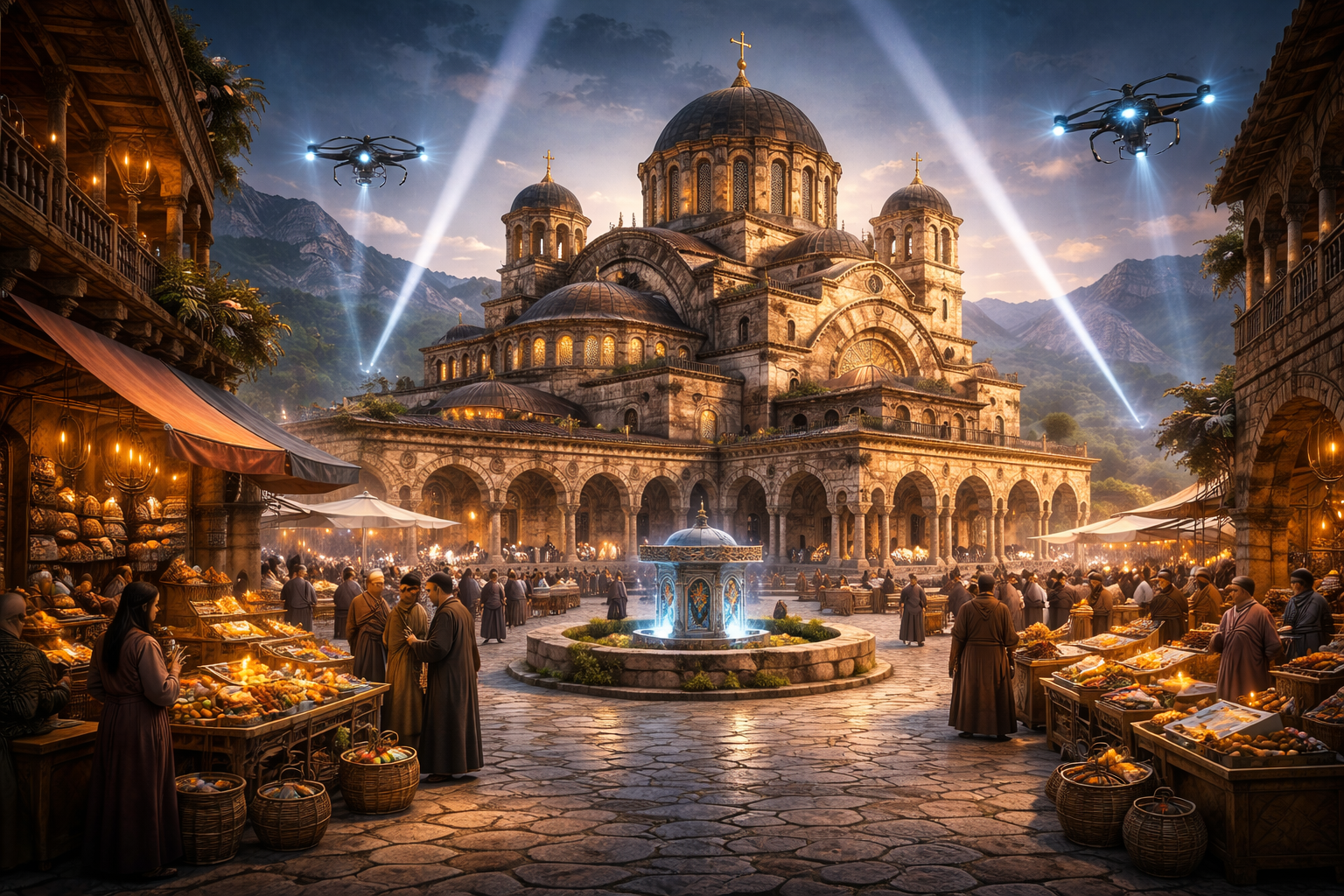
AI reconstructs the Demre that never existed with ease.
Too much ease — and that is what feels unsettling.
In the visualizations, the Church of Nicholas grows upward rather than sinking downward. It gains additional levels, luminous drums, inner courtyards. Mosaics do not abruptly end — they continue. Inscriptions become multilingual: Greek, Latin, Syriac, Ottoman, modern Turkish — all within a single space, without “periods.”
The surrounding city is dense but not chaotic. Narrow streets, shadows, trading galleries, porticoes. Not a postcard, but a working city, where the church is not an attraction but a reference point.
AI does not depict ruins. It depicts use. Worn steps. Reinforced domes. Signs of repair rather than collapse.
This is what truly disturbs: the algorithm seems convinced that this city was meant to exist.
As if we are not imagining — but restoring a deleted file.
Reality Blurred
And this is where the problem begins.
Because the real Demre exists as well. But only as a fragment. As a comment on a future that never arrived.
We walk through the Church of Nicholas and see not walls, but limitations. What could not be saved. Where the process stopped. Where someone decided that “this is enough.”
The AI version feels more logical. More complete. More humane. In it, the city is not punished for its geography. It is not erased by time. It simply lived.
The boundary between fiction and reality dissolves not because AI is convincing, but because real history too often resembles a poorly written script — with abrupt cuts, awkward pauses, and endings without epilogues.
We believe in the Demre that never was because the real Demre ceased being a city too early — and became an object too quickly.
Echo in the Void
Standing inside the Church of Saint Nicholas, it is easy to catch a strange sensation: you are inside a future that never happened.
Not the past — precisely the future. A fragment of it.
Everything here feels unfinished. Like a space that expected continuation and never received it. And so imagination does what it does best: it completes the structure.
This article is not an attempt to rewrite history. It is an attempt to honestly admit that sometimes a fictional version of the world feels more ethical than the real one.
Demre of Saint Nicholas did not survive. But it could have.
And that is enough for it to continue existing — at least here.
#VoiceOfRuins #DelusionsAtTheEdgeOfTime #Demre #Myra #ChurchOfSaintNicholas #AlternativeHistory #AIReconstructions #ImaginedPast #CitiesThatNeverWere #ArchitectureOfMemory #HistoryAsSimulation


Our Telegram-channel: Voice Of Ruins https://t.me/Voice_Of_Ruins
Our Instagram: Voice Of Ruins https://www.instagram.com/voiceofruins/
Our group on Facebook: Voice Of Ruins https://www.facebook.com/share/g/16aitn9utM/
Our site: Voice Of Ruins https://www.voiceofruins.org



Leave a Reply