
Exhibits of Surviving History
Hall of the Survivors
History loves victors. Archaeology loves survivors.
The underground cities of Cappadocia are not “marvels of engineering” and not “ancient mysteries.” They are traces of a civilization that never trusted the surface. The people who carved them did not hope things would get better. They planned for the worst — and time proved them right.
Up above, something was always happening: empires changed, religions shifted, tax systems collapsed, languages mutated, flags replaced one another. Down below, the same thing happened again and again: they lived, they breathed, they waited.
These cities were not built in a single attempt. They were deepened when danger increased. Expanded when threats dragged on. Abandoned when life on the surface became temporarily possible. And reclaimed when it wasn’t.
Out of dozens of underground complexes, only a handful survived. The rest collapsed, were dismantled, or erased from memory. These five are not the best. They simply turned out to be durable.
Inventory of the Survivor
Kaymaklı
The City of Habit.
Kaymaklı is not a shelter. It is underground routine, refined into automation. Everything here is designed for repetition: the same movements, the same routes, the same ceiling height — calculated not for an upright body, but for a bent one.
No one hid here in panic. People knew they would return. Niches for grain, stalls for livestock, wine presses — everything speaks of long-term habitation. The stone is not decorated or softened. It is subordinated to the body: elbow, knee, spine.
Today Kaymaklı is lit, cleaned, mapped. It has become comprehensible — and therefore less frightening. Tourism has turned survival into an exhibition.
Derinkuyu
The City of Distrust.
Derinkuyu is fear turned into a system. When hiding is no longer enough — when you must disappear completely. Depth, layers, isolation, rolling stone doors — everything here denies the enemy even the smallest chance.
This is an underground world built not for life, but for prolonged waiting, for an end to a threat that might never arrive. Churches, schools, communal spaces — evidence that people prepared to spend a major portion of their lives here. Perhaps the best part.
Today Derinkuyu is safe. Too safe. It demonstrates the power of the system but conceals its price. It becomes easy to forget that each step downward is a step into voluntary burial while alive.
Mazı
The City of Incompletion.
Mazı makes little impression. And this is its strength. It is unfinished, asymmetrical, never perfected. A city that grew out of necessity, not design.
Here, improvisation is visible everywhere: corridors that suddenly end, rooms tighter than comfort allows, stone walls erected in haste. These are traces of urgent decisions — not architecture, but reaction.
Mazı still balances between monument and trace. It has not yet fully submitted to tourism. And therefore it still speaks quietly — but truthfully.
Nevşehir
The City of Function.
Nevşehir is the strangest of them all. Emotionless. Massive. Technically refined — yet cold. There is less domestic life here and more infrastructure. More system than family.
It feels less like a shelter and more like a subterranean layer of the city, a backup circuit of existence. And in this — its disturbing modernity.
Today Nevşehir is actively formatted for display. It is becoming a product. And with every year, it loses the sense of danger for which it was once created.
Güzelyurt
The City Without Translation.
The simplest. The most uncomfortable. The most honest.
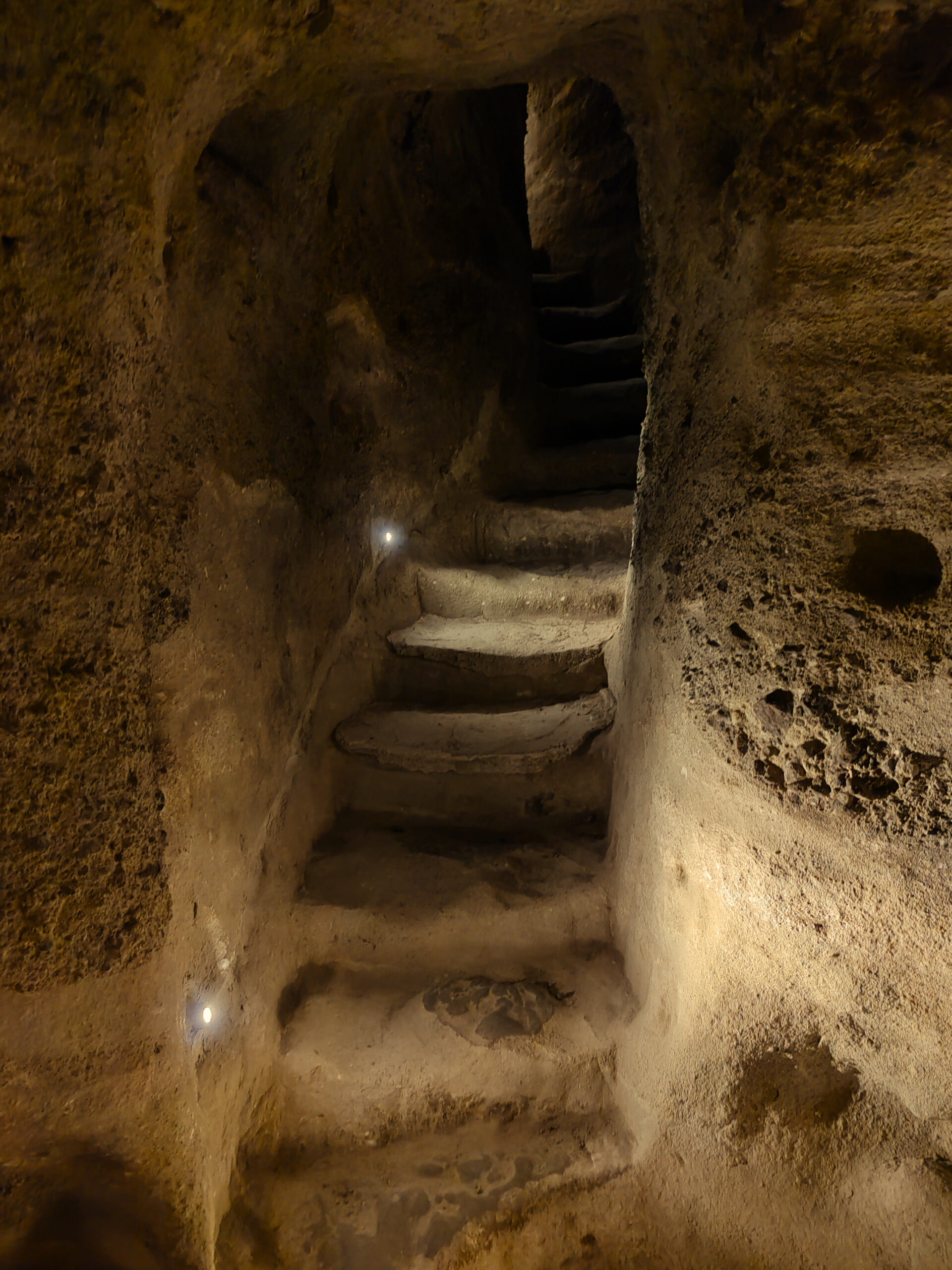
Güzelyurt is not adapted. It does not explain itself. It does not care about your height, breathing, or claustrophobia. The passages are low. The corridors narrow. The descents steep. Here, error is physical — not conceptual.
That is precisely why Güzelyurt matters more than the rest. It never became a museum. It remained a trace of real existence. Here, you see how people lived — not how we want to imagine them living.
This is not a site for mass visitors. It is an experience that demands the body.
Erosion of Memory
Time did not destroy these underground cities. People did — gently, under the pretext of preservation.
Lighting, ventilation, leveling, handrails, routes. All of it saves the structures — and kills the sensation. An underground city without risk becomes a decoration.
Kaymaklı, Derinkuyu, Nevşehir — today they are safe.
Mazı — on the edge.
Güzelyurt — resisting.
The more care — the less truth. The less intervention — the greater the tension.
Shadows at the Edge of Reason
Why did these survive?
Because fear is more durable than culture. Because tuff forgives mistakes. Because underground architecture is never built for display. Because no one wanted to live here forever — and therefore no one overloaded the system.
These cities outlived empires because they were not empires. They did not seek dominance. They simply waited.
How to See This Now
If you want to understand — start with Kaymaklı or Derinkuyu.
If you want to feel — go to Mazı.
If you want scale — Nevşehir.
If you want discomfort and truth — Güzelyurt.
Do not look at dimensions. Look at where — and how — you must bend.
Echo of the Display Case
Underground, the sense of progress disappears. There is no future there. Only continuation.
These cities are not about antiquity. They are about instructions — for when life on the surface becomes impossible again.
When you return above, sunlight feels temporary. And stone feels like a contingency plan.
#VoiceOfRuins #ExhibitsOfSurvivingHistory #Cappadocia #UndergroundCities #Derinkuyu #Kaymaklı #Mazı #Güzelyurt #Nevşehir #ArchitectureOfSurvival #Underground #TracesOfLife #ErosionOfMemory #HistoricalInfrastructure #HumanFear #StoneAndTime


Our Telegram-channel: Voice Of Ruins https://t.me/Voice_Of_Ruins
Our Instagram: Voice Of Ruins https://www.instagram.com/voiceofruins/
Our group on Facebook: Voice Of Ruins https://www.facebook.com/share/g/16aitn9utM/
Our site: Voice Of Ruins https://www.voiceofruins.org
More Points On The Map



Leave a Reply