
The Call of Emptiness
Point of Disappearance
There are valleys that display themselves. And there are those that preserve evidence.
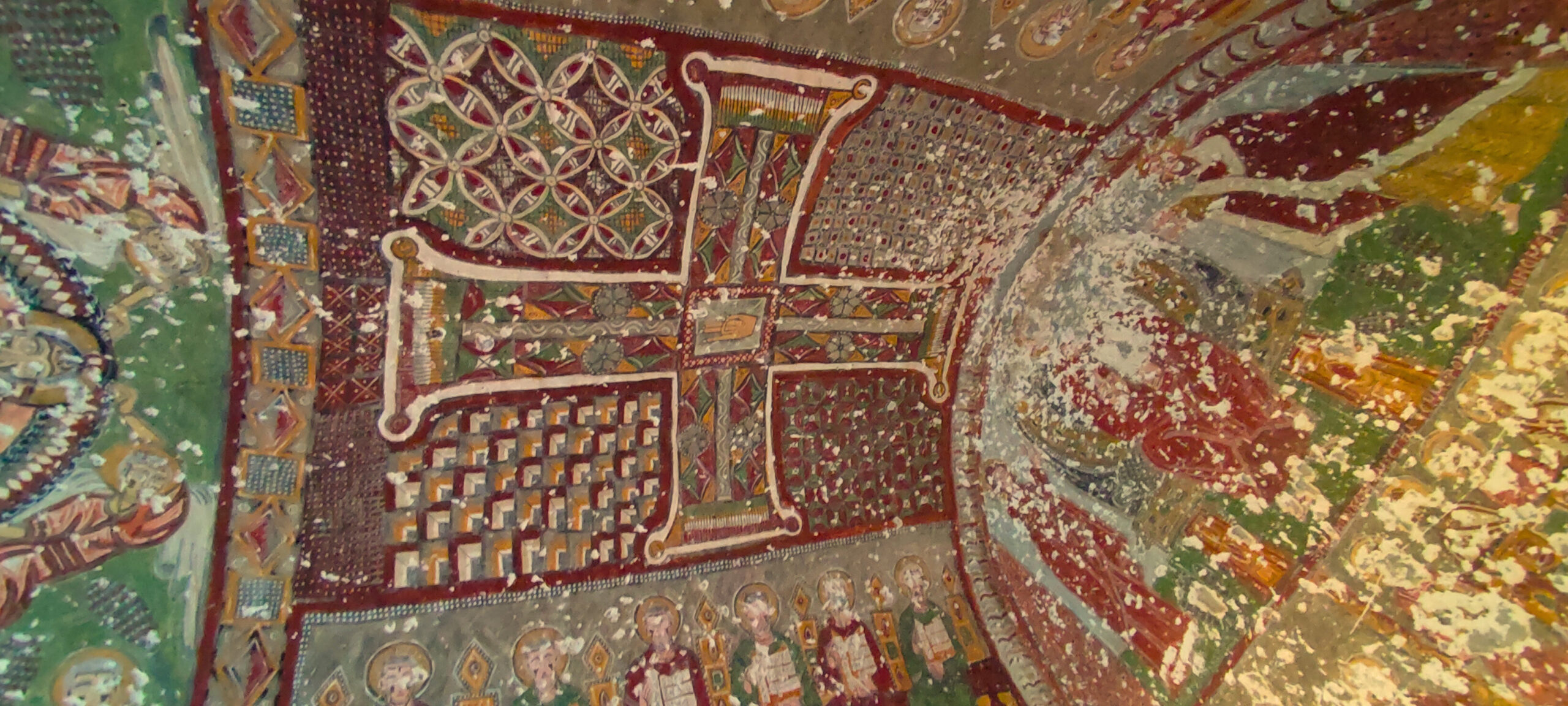
Ihlara does not tell its story directly. It leaves clues. Shards of lamps, fragments of frescoes, worn steps, hollows in the stone floor polished by thousands of footsteps. You step into the canyon — and instantly find yourself not in a space, but in an archive, where documents are arranged not on shelves, but across rock walls.
Nothing is explained here. You are simply given the chance to see that someone once existed. Lived. Breathed. Waited. Hid. And then vanished — as quietly as they arrived.
Ihlara is not a museum. It is a place where time is not displayed, but concealed.
Landscapes Without Hope
Along the route, hundreds of cave chambers are scattered: dwellings, chapels, storerooms, stables, workshops, tunnels. No symmetry. No architectural logic. Only adaptation.
The tuff allowed everything life required to be carved into the rock: shelves for utensils, niches for lamps, water channels, smoke vents, secret exits, hidden passages that today look like geological anomalies.
Every hollow is not decoration. It is the trace of a decision. Every meter — a compromise between fear and necessity.
The Cry of Stones
The artifacts of Ihlara rarely look like “treasures.”
They are not gold or marble. They are ceramics. Iron. Stone. Soot. Lime. Traces of fire, water, breath.
Fragments of oil lamps. Shards of jugs. Remains of mill mechanisms. Fruit pits. Worn thresholds.
Objects unfit for display cases. And yet they speak the loudest.
Because these are not objects of faith. They are objects of everyday life.
Ihlara cries not with legends, but with routine.
Shadows on the Edge of Reason
Among these traces arises a strange feeling: you are not looking at the past — you are standing inside someone’s interrupted present.
Here are the steps walked every day. Here the niches where food was placed. Here the soot marks of a lamp lit before sleep.
You begin to understand: life here was not “ancient.” It was ordinary.
With its worries. Its fatigue. Its habits. Its hope postponed.
And suddenly it becomes clear: the mysticism of Ihlara is born not from the sacred, but from vanished domestic life.
We do not hear the voices of those who lived here — and that is why it seems to us that we hear silence.
Traces on the Map
— More than 100 rock-cut churches, chapels, and monastic spaces
— Hundreds of residential caves
— Remains of mills, canals, bridges
— Traces of agricultural terraces
— A system of secret paths and exits
— Artifacts from the 4th–13th centuries
This is not an ensemble. Not a monument. It is an infrastructure of life, stretched across centuries. And that is why it does not look monumental. It looks functional.
Echo in the Emptiness
Six texts. Six attempts to approach one place from different angles. Geology. Psychology. Mysticism. Function. Everyday life. Traces.
And still Ihlara does not form a complete image. Because a valley is not an object. It is a process — and one that has not yet ended.
It does not preserve meaning. It creates conditions in which meaning becomes possible.
Ihlara does not tell a story. It shows how humans adapt, vanish, return, survive, and leave.
You exit the canyon with the feeling that you understood nothing. And this feeling is the most accurate of all.
Because true archives do not give answers. They leave questions that cannot be closed.
Ihlara is one of those archives. Open. Silent. Endless.
#VoiceOfRuins #CallOfEmptiness #Ihlara #Cappadocia #archaeology #artifacts #cavecities #history #tracesoftime #humanandenvironment #archiveofsilence


Our Telegram-channel: Voice Of Ruins https://t.me/Voice_Of_Ruins
Our Instagram: Voice Of Ruins https://www.instagram.com/voiceofruins/
Our group on Facebook: Voice Of Ruins https://www.facebook.com/share/g/16aitn9utM/
Our site: Voice Of Ruins https://www.voiceofruins.org



Leave a Reply