
Calendar of Oblivion
Gates of Time
There is a day when the calendar stops being accounting and becomes magic again. When numbers tear off their masks and show their teeth. When the world takes a step back in order to leap over itself.
Chinese New Year is not a date. It is a rupture.
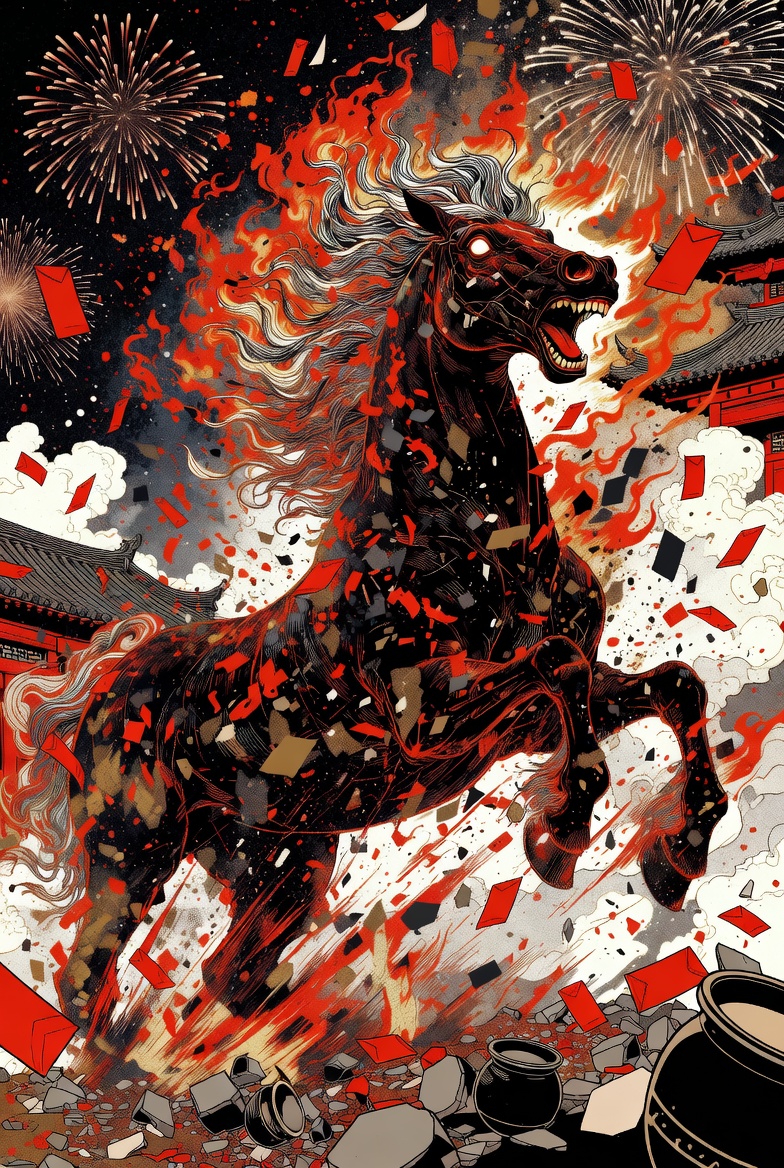
It does not begin “on the night from the 31st to the 1st.” It begins when the Moon, the Sun, and ancient formulas agree that humanity once again needs the illusion of reboot. In 2026, this rupture opens on February 17 — at the moment when the Horse of Fire enters the stage.
The Horse is speed. Fire is malfunction. Together they produce the very thing all stable systems fear: abrupt movement without instruction.
The Chinese calendar is not merely a way of counting days. It is an operating system of civilization, where each year is a separate behavioral module. One is about patience. Another about accumulation. A third about war. The Year of the Fire Horse is about escape from the cage, even if there is no air beyond it.
Legends say that once the New Year began with blood. People sacrificed to spirits so they would not devour entire villages. Later, blood was replaced by wine, fire by fireworks, and fear by superstition. But the code remained unchanged: the world must be frightened in order to reboot it.
Feast Behind the Black Veil
The celebration lasts fifteen days. Fifteen days of legalized madness.
Cities are drenched in red — the color of blood, the sun, and a hacked matrix. Exploding firecrackers are meant to scare away spirits, but in truth they terrify people, reminding them how easily everything collapses.
Dancing lions and dragons flood the streets — hybrids of nightmare and circus. Masks, drums, smoke, the hoarse metal of gongs. Dance here is not aesthetics, but a physical formula: motion against stagnation.
Families gather around tables buckling under food. Fish, dumplings, noodles, sticky rice. Everything carries meaning. Fish — abundance. Noodles — long life. Dumplings — wealth. Even the shape of food becomes a magical code embedded directly into the stomach.
Alcohol flows slowly but relentlessly. The old remember the dead. The young make wishes for the future. Children receive red envelopes filled with money — an advance payment for the illusion of stability.
All of this looks like domestic warmth. But beneath the tablecloths hides archaic machinery: a collective ritual of rewriting fate. People attempt to negotiate with chaos through noise, grease, fire, and rhythm.
A holiday is an ancient drug, legalized by tradition.
Gods Among Us
Formally, the festival is dedicated not to gods, but to the calendar. Yet the calendar itself is a god disguised as a table.
In ancient times, people fed ancestral spirits, household deities, and the gods of the kitchen, earth, wealth, and fortune. They offered food, incense, and paper replicas of money, houses, cars, and servants. All of it was burned so that comfort might reign in the realm of the dead.
Today, paper iPhones and paper villas fly into the flames — an upgrade for the afterlife.
Chinese New Year is a mass simulation of caring for the dead so they do not interfere in the lives of the living. We pay the past so it does not send us the bill.
The Horse here is not merely a zodiac sign. It is an archetype of movement, a herald of change, transport between worlds. Fire is the language of gods, a universal translator between fear and hope.
When the Horse of Fire arrives, the gods walk the streets. Not as statues, but as glitches: sudden decisions, abrupt relocations, breakups, leaps, resets.
The festival reminds us: order is temporary, chaos eternal.
Shadows at the Edge of Reason
Why does humanity need holidays if it has long understood that they hold no inherent meaning?
The answer is simple: not to go insane.
Ritual creates the illusion of structure. It makes chaos predictable, locks it into form, into script, into fireworks scheduled by the clock. When destruction follows a plan, it stops being terrifying.
Chinese New Year is a rehearsal of the apocalypse. In miniature. With noise, smoke, fire, panic, and purification. So that the real end of the world, should it ever arrive, will not catch us unprepared.
The Year of the Fire Horse is especially dangerous for those who cling to stability. It drags hidden conflicts into the open, accelerates events, erases compromises. In such years, the world stops explaining itself.
The philosophy of this festival is simple: if order is doomed to collapse anyway — let us make it beautiful.
How Did We Get Here?
By the Gregorian calendar, Chinese New Year falls between January 21 and February 20. In 2026, it is February 17. Fifteen days follow, up to the Lantern Festival — the final chord of luminous chaos.
Today it is celebrated far beyond China. Taiwan, Korea, Vietnam, Singapore, Malaysia, vast diasporas in the United States, Europe, Australia — the entire world turns into a branch of an ancient ritual center.
Festivals, reconstructions, parades, markets, museums, fire shows, digital broadcasts — the holiday has become a global franchise. Yet its core remains unchanged: a collective attempt to convince the Universe that everything is starting over.
How does one survive a modern celebration? Do not try to understand everything. Do not seek rational meaning. Simply allow chaos to be beautiful.
Echo in the Void
When you observe Chinese New Year from the outside, it looks like theater. Beautiful, loud, slightly insane. But if you remain inside it — even for a few days — you realize: this is not a show. It is collective hypnosis.
You begin to feel time grow viscous. Past and future blend into a single thick substance. People around you stop being functions for a moment and become a tribe again.
At some point, a thought catches you: what if everything truly can begin anew? Not the year. Not life. Just the morning.
And it is precisely here that the festival wins.
It offers no answers. It offers a pause. A breath between two versions of reality. A moment when it seems the world can still be rewritten.
The Horse of Fire is already galloping. The calendar is burning. Ash settles over the streets. And we stand in this smoke, pretending we know where we are going.
#VoiceOfRuins #CalendarOfOblivion #ChineseNewYear #YearOfTheFireHorse #Rituals #Festivals #Mythology #ChineseCulture #PhilosophyOfCelebration #Chaos #Fire #Calendar #ArchitectureOfChaos #AncientTraditions #DustOfTime #ShadowsAtTheEdgeOfReason
Our Telegram-channel: Voice Of Ruins https://t.me/Voice_Of_Ruins
Our Instagram: Voice Of Ruins https://www.instagram.com/voiceofruins/
Our group on Facebook: Voice Of Ruins https://www.facebook.com/share/g/16aitn9utM/
Our site: Voice Of Ruins https://www.voiceofruins.org
More Points On The Map




Leave a Reply