
Artifact of Inevitability
The Gaze Through Glass
There are artifacts that simply lie inside display cases. And then there are those that make you feel the glass protects not them from us, but us from them.
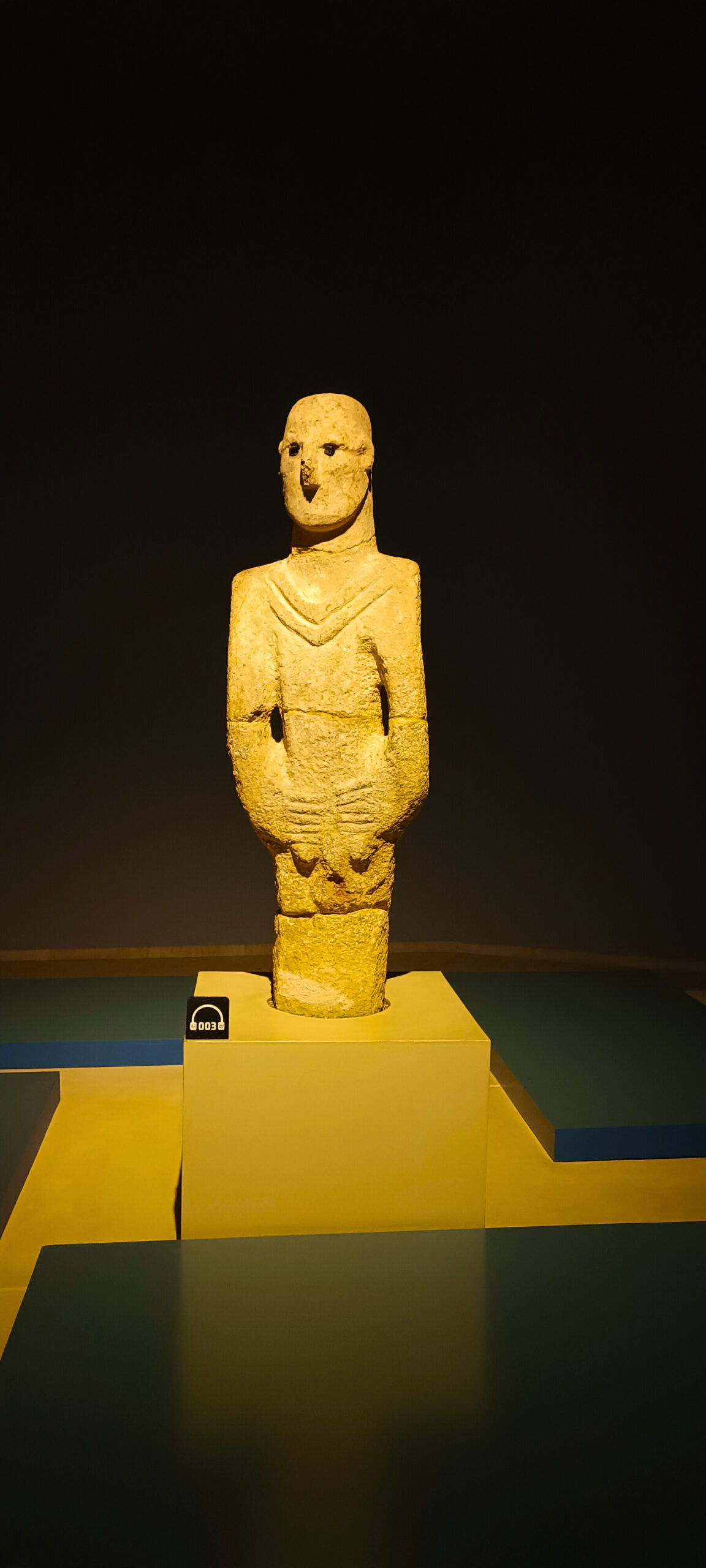
In one of the halls of the Archaeology Museum in the city of Şanlıurfa stands a man. Not exactly a man. More like the idea of a man carved from stone.
He is almost life-sized. His shoulders are slightly tense. His hands are folded over his stomach, as if he is trying to keep some ancient secret locked inside himself.
But the most important thing is the eyes. Black. Deep. Made of obsidian.
If you stare at them for too long, an uncomfortable feeling begins to grow: he is not just looking — he is recognizing.
And then a strange thought arrives. This figure was looking at people thousands of years before humanity invented history.
Matter and Myth
Archaeologists discovered him in 1993 near the sacred pool of Balıklıgöl. He had been hidden underground for almost ten thousand years.
Height — about 1.8 meters. Material — limestone. Eyes — obsidian. Age — approximately 9,000–9,500 years.
This was a time when the world did not yet know cities. Did not know states. Did not know gods in the way we imagine them today.
And yet there were already people carving life-sized human figures out of stone.
Not far from Urfa stand the megaliths of Göbekli Tepe — massive stone circles built by hunter-gatherers long before the emergence of civilization.
It was a strange era. People could not write yet. But they already knew how to create eternity.
The Urfa Man is one of those experiments.
His face shows no emotion. He has no mouth. Only a gaze.
As if the one who created him had decided something simple: Words disappear. Sight remains.
The Eye of the Past
Imagine the moment of his birth.
Night. Fires burning. The smell of limestone dust.
Someone works with a stone tool, slowly carving a face.
The people around him do not yet know words like “art” or “sculpture.” But they already feel a strange urge to leave someone behind.
They carve the body. The hands. The shape of a face.
Then someone brings pieces of obsidian — volcanic glass.
They place them into the eye sockets. And at that moment, the stone stops being stone. It becomes a watcher.
The figure is placed in a niche in the wall. People enter the room, and every single one of them feels the same thing: They are being watched.
Who was he? A god. An ancestor. A guardian.
Or perhaps the first attempt by humanity to create a presence that does not die.
Legacy in the Dust
Civilizations like to believe they are eternal.
They build cities. Empires. Temples.
But centuries pass, and everything becomes dust.
The Assyrians disappear. The Romans disappear. Byzantium disappears.
Even the memory of them begins to dissolve.
But the stone man continues to watch.
Sometimes it feels as if the people who created him understood one simple truth: Humans disappear faster than their questions. Who are we? Why are we here? Who is watching us?
The Urfa Man is not just a statue.
It is a pause in history that has lasted nine thousand years.
How Did We Get Here?
Today this ancient observer stands in the Archaeology Museum of the city of Şanlıurfa.
Around him are dozens of other finds from the Neolithic era, along with reconstructions of the sanctuaries of Göbekli Tepe.
But among them he feels different. Because most ancient objects tell a story.
This one asks a question.
When you stand in front of him, a strange feeling appears.
As if we are not looking at the past. As if the past is looking at us.
And perhaps that is exactly why he has no mouth. He remains silent.
Because he knows that in a few thousand years someone will stand in front of our ruins and look at them in exactly the same way.


Our Telegram-channel: Voice Of Ruins https://t.me/Voice_Of_Ruins
Our Instagram: Voice Of Ruins https://www.instagram.com/voiceofruins/
Our group on Facebook: Voice Of Ruins https://www.facebook.com/share/g/16aitn9utM/
Our site: Voice Of Ruins https://www.voiceofruins.org



Leave a Reply