
Dust of Time
Entering the Labyrinth
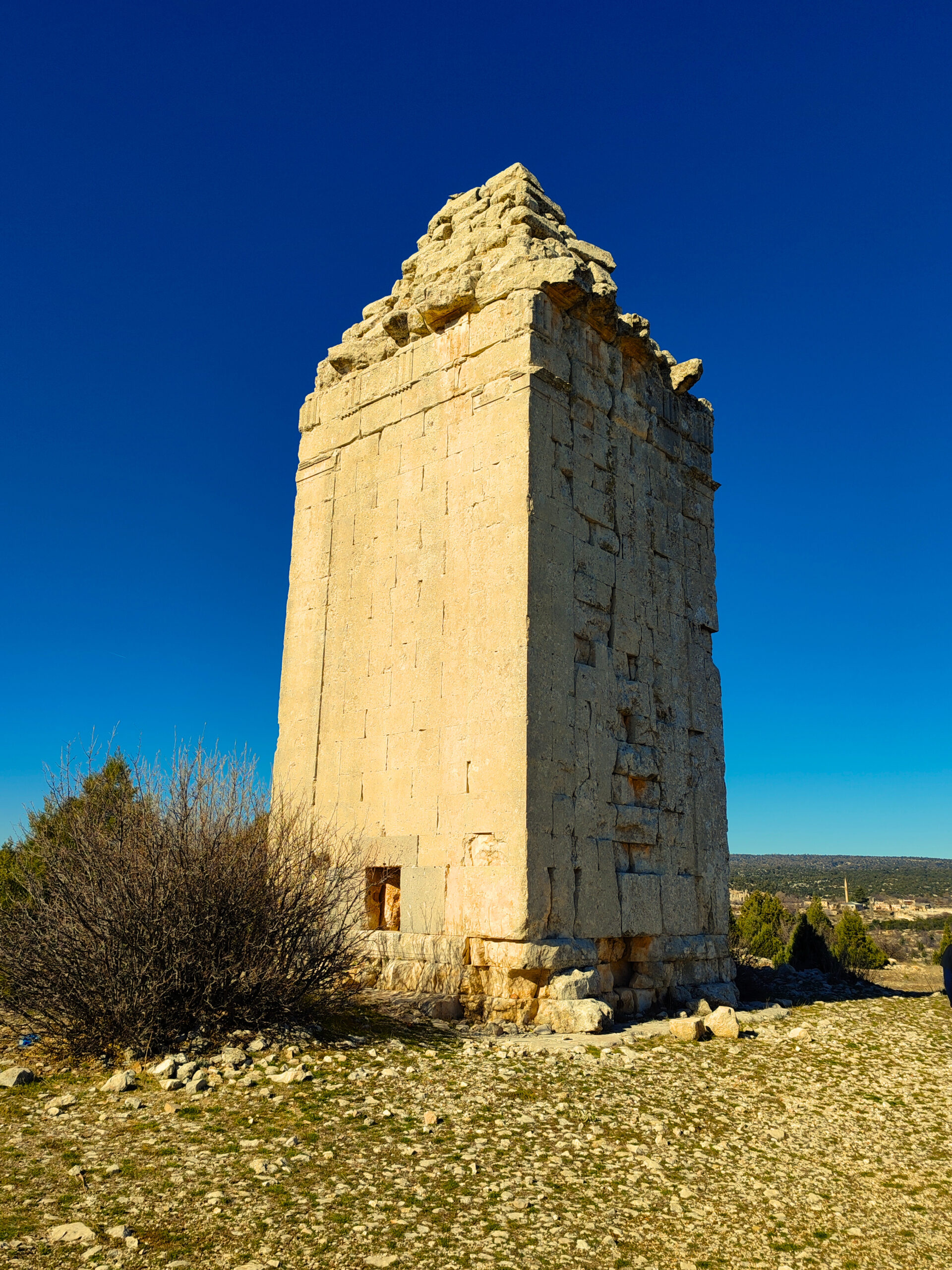
You climb the mountain road, the air becomes thinner, and the sky gets closer. Suddenly, amid the chaos of the Taurus Mountains, a flat platform appears, as if someone cut out a piece of reality with scissors. And from this platform a finger sticks out. Twenty-three meters of stone that looks at you as if you are just another tourist it has already seen thousands of times.
This is not ruins. This is an interface.
Here, at an altitude of 1200–1300 meters, in ancient Cilicia Trachea, stands Uzuncaburc — the former Diocaesarea, the former sacred place of Olba. A place where gods did not die, but simply updated their firmware. Where priests bore the names of Trojan War heroes, and Romans tried to rename everything into “City of the God-Emperor”, as if it could change anything.
You enter — and the labyrinth opens. Not from stone. From time.
Welcome to the system that has been working for 2300 years and has still not crashed.
Past the Empires
It all began long before the Greeks invented the word “Hellenism”.
This place was already sacred in Hittite-Luwian times. Then the Seleucids came. Around 300 BC, Seleucus I Nicator — one of Alexander the Great’s generals, who decided that half the world was not enough for him — rebuilt the Temple of Zeus Olbios here. Why exactly here? Because the temple was already standing. Because the signal was already there. Because even the conquerors felt: this place is not just stone. This is a point of access.
According to the legend preserved by Strabo, the temple was founded by Ajax himself — the very hero of Troy, son of Telamon. The priests belonged to the Teucrid dynasty: every man in the family bore the name either Ajax or Teucer. Imagine: a theocracy where power is transferred not by ordinary blood, but by name. You are not just a ruler — you are an incarnation. You have already been here before. You will be here again.
The main city of the region – Olba, was located 4 km to the east. And Uzuncaburc was precisely the sacred precinct — hieron. The priest-kings ruled all of Cilicia Trachea in the name of Zeus. Not with the help of an army. Not by collecting taxes. Just a direct connection to the divine server. They minted coins with the image of the temple. They built towers and fortresses. One of them is that very Hellenistic tower 23 meters high, base 16×13 m, built in the second half of the 3rd century BC by a certain Tarkyares (or on his order). The inscription above the entrance still tells: this was done by a man whose name sounds like it came from another dimension.
The Romans came in 72 AD under Vespasian and said: “Enough of theocracy, let’s make a normal city”. They separated the sacred place from Olba, named it Diocaesarea (“City of the God-Caesar”) and gave the right to mint their own coins. They built colonnaded streets with shops, a theater for 3000 seats (built in 164 AD under Marcus Aurelius and Lucius Verus, later restored), a temple of Tyche (goddess of fortune — because even the Romans understood: without her nothing works), a fountain, necropoleis, aqueduct.
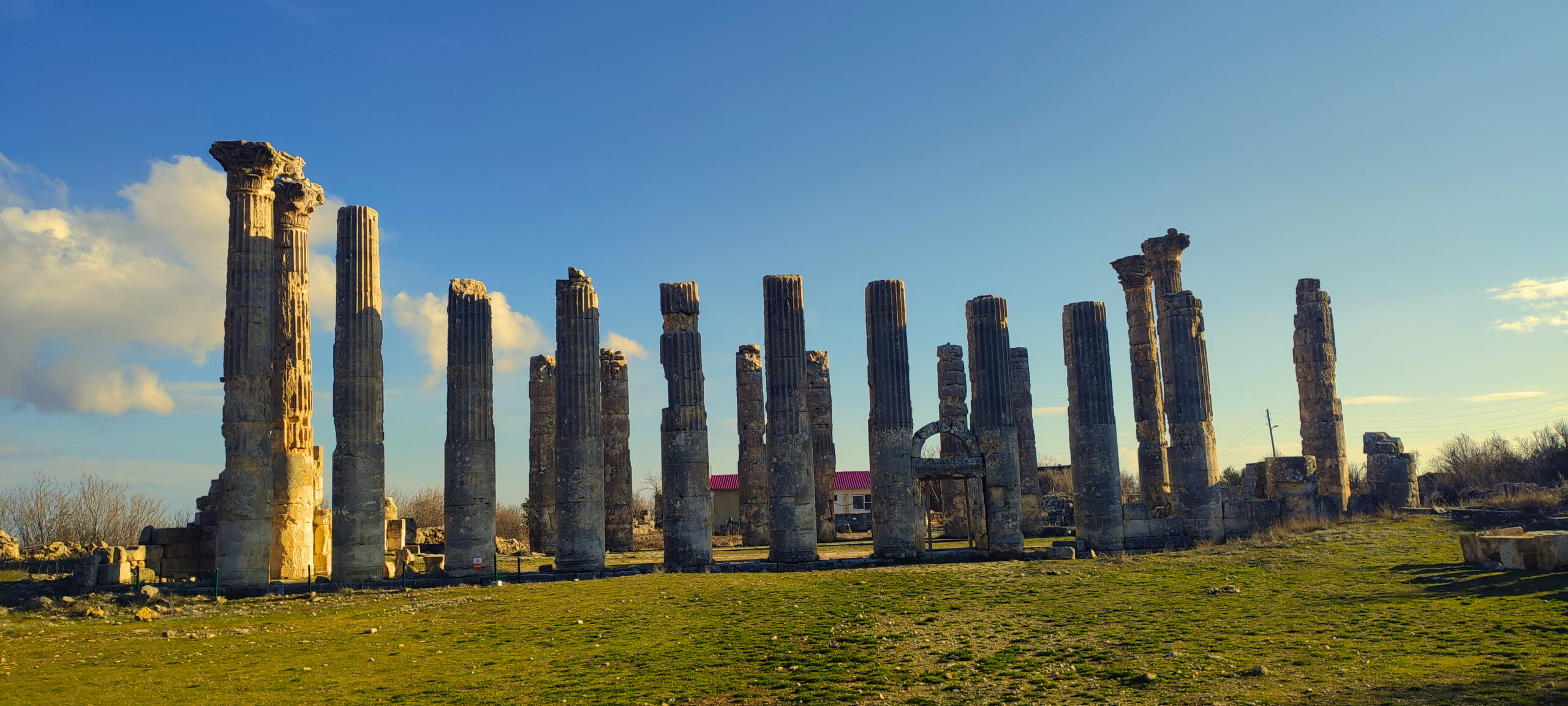
The Temple of Zeus — a peripteros with 36 columns — was turned into a church in the 5th century. The columns stood, the reliefs smiled. The gods simply changed their costume.
In Byzantine times life was still boiling here: at the end of the 6th — beginning of the 7th century, during the war with the Sasanians, people hid in that same tower. Archaeologists found 19 artifacts there in 2021: a skeleton, a necklace, a pendant, an earring, an amulet, a bracelet, a pectoral chain. Someone was hiding, someone was dying, someone hoped that the tower would protect them.
And in 2025, in one of the Roman shops on the colonnaded street of Uzuncaburc, they found something completely strange: a full set of iron scales and five weights in the shape of Greek letters — β, γ, σ, ψ, ω. 1600 years ago someone was weighing goods here using a system where units of measurement were letters of the alphabet. As if they were measuring not only oil and grain, but reality itself.
The geology adds madness: the karst limestone of the Taurus Mountains slowly dissolves in rainwater. The stones literally melt. Time here does not just pass — it eats away at the material from which the simulation is made.
Fragments of Now
Today Uzuncaburc is a village where chickens walk between Corinthian columns, and locals drink tea in the shade of 2300-year-old stones. The ruins are in amazing condition for their antiquity: ceremonial gates 7 meters high (the inscription says they were repaired under Arcadius and Honorius after an earthquake), a monumental fountain, remains of an aqueduct, a necropolis on the slopes of the valley, a pyramidal mausoleum with a square base 5.5×5.5 m and a height of about 15 meters.
The theater is currently being restored. The tower is still the dominant feature, the symbol of the place. In recent years, active excavations and restoration are underway: the temenos (sacred enclosure), the tower, the theater. In 2025, those same scales were found — a rare set that tells about the commercial life of the late antique city.
Everything is still alive. But alive in its own way. As if the program is running in the background while users think it is just a “sightseeing spot”.
Shadows on the Edge of the Mind
And now the main thing that makes this place not just ruins, but a glitch in the matrix.
Imagine: priests who called themselves Ajaxes and Teucers ruled in the name of Zeus Olbios (syncretism with the local Luwian god). Then the Romans renamed the place in honor of the emperor-god. Then Christians turned the temple into a church. Then the Turks came and named everything after the tower — “Long Tower”. Uzuncaburc.
Every time a new wrapper. Every time the same signal.
What if this is not a change of civilizations, but one long experiment?
What if the tower is not a defensive structure and not a symbol, but an antenna?
What if the weights in the shape of Greek letters measured not only goods, but the weight of souls, the weight of faith, the weight of oblivion?
You stand between the columns, the wind from the mountains hits your face, and suddenly you realize: you are not looking at the ruins. The ruins are looking at you. They saw how the Seleucids, Romans, Byzantines, Sasanians, Ottomans came and went. They saw how people changed the names of gods, how they changed their own names.
And now they look at you and think: “The next layer of dust. I wonder what label he will come up with for himself?”
Here, in Uzuncaburc, time is not linear. Here it is cyclical. Here the gods did not die — they simply went offline, leaving the server to work on autonomous power. And the tower is still broadcasting: “Are you still here? Continue. We are watching.”
How Did We Get Here?
You can get to Uzuncaburc, although with adventures. You fly to Antalya or directly to Mersin, then bus or rented car to Silifke. From there — 30 km north along a mountain road. Serpentines, but the asphalt is normal. The altitude makes itself felt — take water, comfortable shoes, a hat. The best time is early morning or closer to sunset: the light falls in such a way that the columns come to life, and the shadows become long, like memories.
Entrance is inexpensive, there is a Turkish Museum Card. Nearby — ancient Olba with an aqueduct and rock-cut tombs, canyons, Kızkalesi on the coast. You can make a big loop through Cilicia Trachea — places where pirates, priests and emperors played the same game.
Don’t take a crowd with you. This place loves silence. When the wind walks between the columns, you hear it whispering.
Echo in the Void
I stood at the foot of that tower and felt how 2300 years were compressed into one point.
As if someone up there is slowly turning the pages of a huge book, and we are just ink that sometimes forgets to dry.
Here there is no final answer. There is only the question that repeats as an echo between the stones:
“Have you already realized that you are the next Ajax? Or do you still think that your version of reality is the only one?”
The tower is silent. But it smiles with windows and cracks.
#VoiceOfRuins #DustOfTime #Uzuncaburc #Diocaesarea #Olba #TempleOfZeusOlbios #Teucrids #AjaxAndTeucer #WeightsOfLetters #TowerThatRemembers #CiliciaTrachea #RuinsAsAntenna #TimeAsGlitch #TaurusMountains #AncientGodsDoNotDieTheyReboot


Our Telegram-channel: Voice Of Ruins https://t.me/Voice_Of_Ruins
Our Instagram: Voice Of Ruins https://www.instagram.com/voiceofruins/
Our group on Facebook: Voice Of Ruins https://www.facebook.com/share/g/16aitn9utM/
Our site: Voice Of Ruins https://www.voiceofruins.org



Leave a Reply