
Dust of Time
Entering the Labyrinth
You come closer, and suddenly you realize: there are not one tower here, but two. One is alive — 23 meters high, with rooms inside where people once hid and treasures were stored. The second is dead, yet not much shorter — a 15-meter pyramidal tomb standing on a hill slightly aside, beyond the city walls, like a silent twin. They gaze at each other across the centuries, as if two fingers driven into the earth by someone who wanted to say: “We are still here.”
This is not just ruins. This is a dual interface.
Here, at an altitude of 1200–1300 meters in the Taurus Mountains, Uzuncaburç becomes a place where the Tower of Tarkyares and the pyramidal tomb operate as an antenna and a receiver of the same signal. Gods changed their names, empires fell, yet these two stones continued to stand and watch.
You enter — and the labyrinth opens now not from time, but from two vertical lines that have never fallen.
Past the Empires
The Tower of Tarkyares is not just a tower. It is a five-storey structure with a base of 16 × 13 meters and a height of 23 meters. Each floor is divided into rooms. It was built in the second half of the 3rd century BC by Tarkyares himself (or on his direct orders), son of the priest Teucer. Above the entrance there is an inscription that can still be read: a man with a name that sounds like a code from another dimension erected this building. It served simultaneously as the priests’ palace, a refuge in times of war, and a treasury. At the end of the 3rd century AD, after a fire, it was repaired by the Roman governor Petronius Faustinianus.
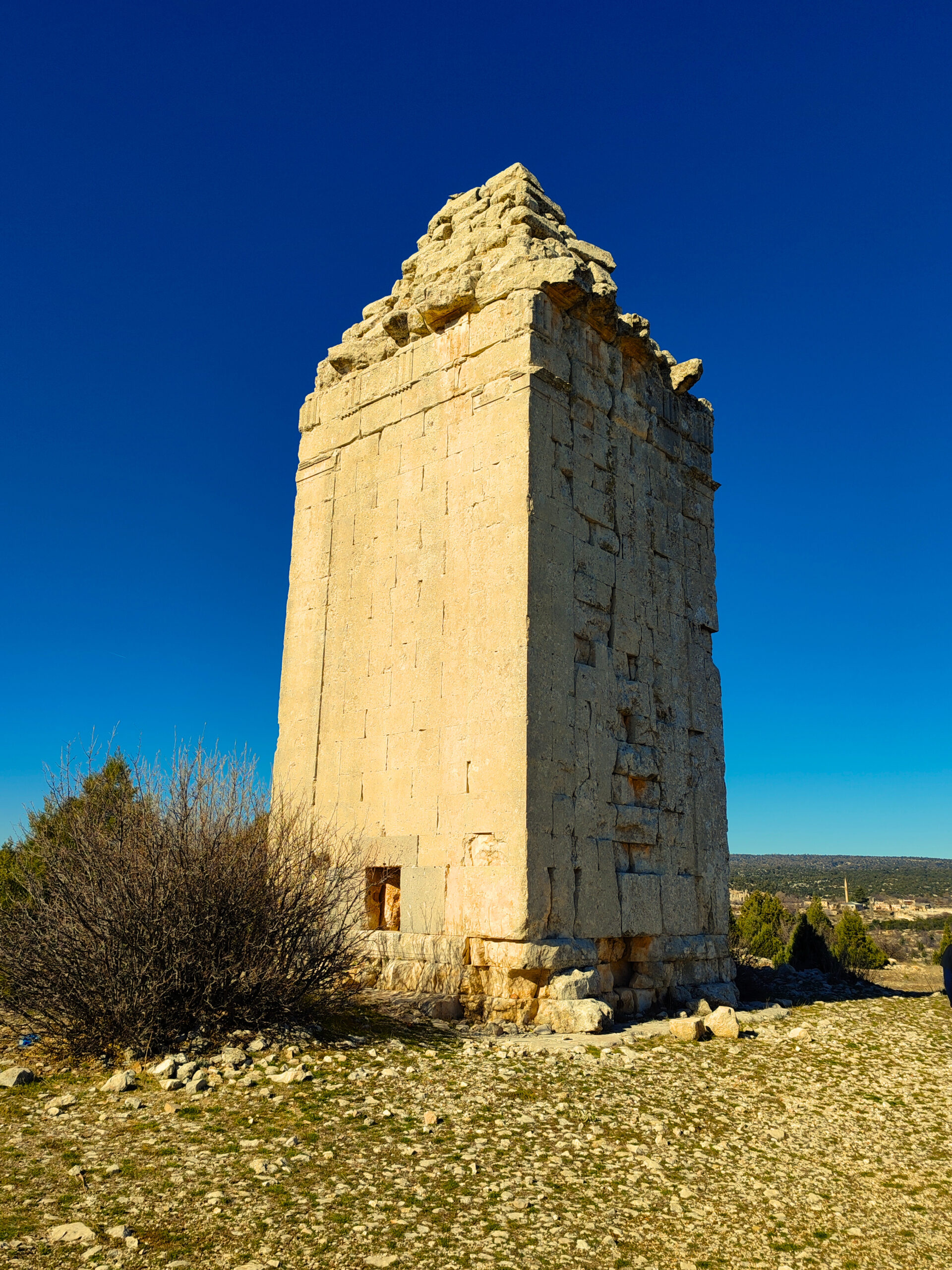
And a couple of kilometers away, on a hill to the southeast beyond the walls, stands the second vertical — the pyramidal tomb. It has a square base of 5.5 × 5.5 meters, a height of about 15 meters, a pyramidal roof, and Doric order. Built approximately in the 3rd century BC. It is one of the earliest monumental mausoleums in the region. Unique: there is nothing like it anywhere else in Cilicia Trachea. It greeted travelers long before the city received the name Diocaesarea. Later it was incorporated into the defense system — as if even the dead were supposed to protect the living.
The Teucrid priests, who bore the names Ajax and Teucer, ruled here in the name of Zeus Olbios. In 72 AD under Vespasian the Romans turned the sacred site into a full-fledged city with the right to mint its own coins. The Temple of Zeus (a peripteros with 36 columns) became a church in the 5th century. Yet the tower and the tomb continued to stand, like two silent witnesses who did not care who was in fashion at the moment: Zeus, Caesar, or Christ.
Fragments of Now
Today both verticals still dominate the landscape. The Tower of Tarkyares is the main symbol of Uzuncaburç. Inside it, in 2021–2022, archaeologists found 19 artifacts from the late 6th – early 7th century: a skeleton, a necklace, a pendant, an earring, an amulet, a bracelet, and a pectoral chain. People hid here during the war with the Sasanians. The tower once again became a refuge — just as it had been 2300 years earlier.
In July 2025, in one of the shops on the colonnaded street, a complete set of iron scales and five weights shaped like Greek letters — β, γ, σ, ψ, ω — were discovered. They are 1600 years old. This is the first such complete set found in the region. As if someone in late antiquity continued to measure reality using the same system where letters served as units of weight.
The pyramidal tomb stands slightly aside, on the hill. Tall like the tower, but already beyond the ancient walls. Its pyramidal roof is still intact. It looks down on the city from above, as if waiting for the next layer of dust to finally understand that it was never just a grave.
Excavations and restoration are in full swing: the temenos, the theater for 3000 spectators, the tower. The place is slowly coming back to life, but according to its own rules.
Shadows on the Edge of the Mind
Now imagine: two verticals. One — a tower full of rooms where the living hid. The second — a tomb full of silence where the dead lay. They stand at a distance, yet they look at each other. Like two poles of one experiment.
What if the Tower of Tarkyares is the antenna, and the pyramidal tomb is the receiver?
What if the scales with Greek letters measured not only oil, but also the weight of souls that passed by them along the colonnaded street?
What if the tomb is not just a mausoleum, but a portal through which the Teucrid priests left this world and returned under new names?
You stand between them. The wind blows from the mountains. And suddenly you understand: they are not just stones. They are two fingers pointing upward. One says: “We hid the living.” The second replies: “We kept the dead.” And together they whisper: “We saw how gods changed their names, yet we remained.”
Here time does not flow. Here it stands vertically. The gods did not die. They simply moved from the tower to the tomb, and then returned. And we are only the next layer of dust that they observe.
How Did We Get Here?
The road is the same: Antalya or Mersin → Silifke → 30 km north along the serpentine. But now do not look only at the tower. When you approach Uzuncaburç from the south, the first thing that greets you is the pyramidal tomb on the hill — tall like the tower, but already beyond the ancient city. It seems to say: “Say hello to me first.”
Bring water, comfortable shoes, and silence. It is best to come closer to sunset, when the two verticals cast long shadows toward each other. Nearby are Olba, canyons, and Kızkalesi. But the main thing is to remain between the tower and the tomb. When the wind walks between them, you hear them talking to each other.
Echo in the Void
I stood between them — the Tower of Tarkyares and the pyramidal tomb — and felt how 2300 years compressed into one vertical line.
As if someone up there is holding two fingers, and we are simply dust falling between them.
Here there is no answer. There is only the question that echoes between the stone and the pyramid:
“Have you already realized that you are the next one who will hide in the tower or lie down in the tomb? Or do you still think that your version of reality is the only one?”
They are silent. But they smile.
#VoiceOfRuins #DustOfTime #Uzuncaburç #TowerOfTarkyares #PyramidalTomb #Diocaesarea #Olba #WeightsOfGreekLetters #TempleOfZeusOlbios #Teucrids #CiliciaTrachea #RuinsAsAntenna #TimeAsGlitch #TaurusMountains #AncientGodsDoNotDieTheyReboot #TwoFingersOfEternity


Our Telegram-channel: Voice Of Ruins https://t.me/Voice_Of_Ruins
Our Instagram: Voice Of Ruins https://www.instagram.com/voiceofruins/
Our group on Facebook: Voice Of Ruins https://www.facebook.com/share/g/16aitn9utM/
Our site: Voice Of Ruins https://www.voiceofruins.org



Leave a Reply