
Artifact of Inevitability
A Look Through the Glass
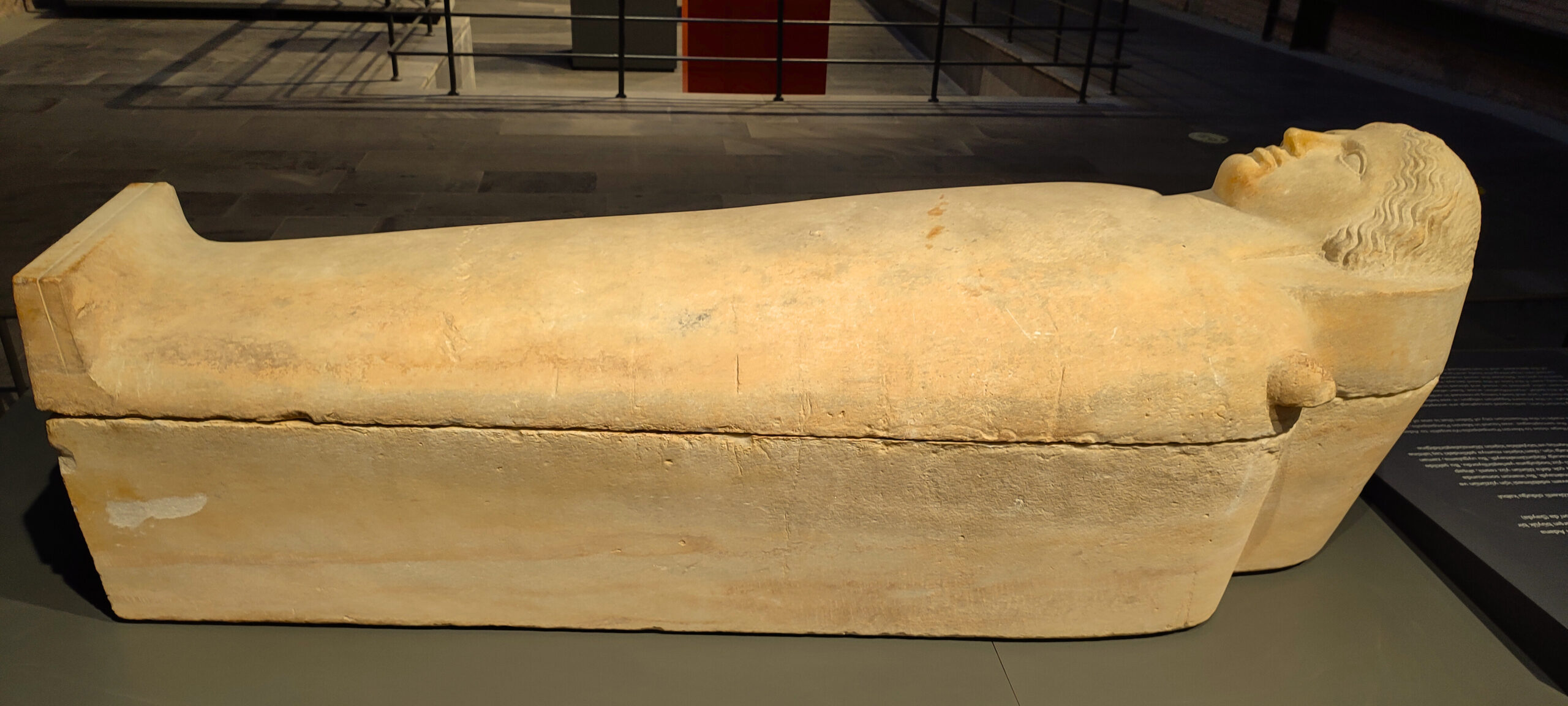
The first thing you see is a face. Not of a person, but of his attempt to explain death to himself. The anthropoid sarcophagus looks as if it has questions, and none of them are designed to have answers. The face is a simplified mask flowing into a body sculpted according to templates long erased from the memory of civilizations.
It stands in the half-light of the Adana Archaeology Museum. The stone has shifted with time, but the expression remains — not human and not divine, something in-between, like a prototype interface written in an epoch when language itself was still in beta. You cannot tell if it looks at you or through you.
And that is the moment of collision: the living and the non-living meeting at the point where memory stops belonging to humans.
Matter and Myth
The sarcophagus is limestone, yet it feels like an alien substance. The anthropoid form came from Egypt, but here in Çukurova it melted together with local traditions: Roman carving, Greek proportions, Semitic nuances of the gaze. It is a cultural hybrid — as if civilizations tried to synchronize their systems, creating a shared body format for the journey beyond the threshold.
The face is carved schematically, without portrait likeness, yet with a strange precision of intent. Not an image of the deceased — the idea of him, packaged into stone. This container is not merely a coffin, but a device built for dialogue with what begins after the body.
Smooth cheekbones, a pointed chin, an elongated silhouette — like an avatar awaiting the upload of a soul.
There are no random details here:
form is instruction;
stone is code;
silence is function.
The Eye of the Past
Who lay inside? History left no name — only an outer shell that once held a person of wealth, power, or fear. Staring at the sarcophagus, you can imagine his trajectory.
He lived in an era when death was not an end but a complex logistical operation. He saw the cities of Çukurova where Akkadian legends, Roman taxes, and Greek philosophy mixed in the same heat. Perhaps he dealt in caravan trade, perhaps in local cults, perhaps in that endless negotiation between human order and chaos.
When he died, the craftsmen made him a face that didn’t need to resemble the original. It wasn’t a portrait — it was a profile for accessing the afterlife, a stone avatar whispering: “Yes, a human lay here, but human is the last of his functions.”
The sarcophagus stood in the earth for centuries, surviving wars, earthquakes, and the fresh paint of new empires. It did not witness eras — it outlived them.
Legacy in Dust
Why do we need an anthropoid sarcophagus today?
First, it shows that humans have always tried to archive themselves in a material that lasts longer than their bodies. Today we use servers and clouds; earlier — stone. The difference is minimal: format changes, essence stays.
Second, this sarcophagus reminds us that death is always described in a language we do not understand. Egyptian body theology, Phoenician aesthetics, Roman symbols — all coexisting here, creating a hybrid object of immortality.
Third, it reveals an odd truth: a portrait after life turns out more accurate than a portrait in life. Because it speaks about fears, desires, and hope — not about a face.
The anthropoid sarcophagus is a mirror showing not the dead, but us: how we try to negotiate with what refuses negotiation.
How Did We Get Here?
To encounter this artifact, you must visit the Archaeology Museum of Adana — a place that gathers the entire heritage of Çukurova under one roof. In one of the halls, among the funerary complexes, the sarcophagus stands almost undecorated, as if it needs no commentary.
It is one of the most atmospheric objects in the museum: you approach it, and the stone face slowly loads you into an era when portraits were made for those who would never see the final result.
Pause. Look. It has something to say — it simply prefers to say it with silence.
#VoiceOfRuins, #ArtifactOfInevitability, #DustOfAges, #AdanaArchaeologyMuseum, #Sarcophagus, #Anthropoid, #Cukurova, #Archaeology, #Afterlife


Our Telegram-channel: Voice Of Ruins https://t.me/Voice_Of_Ruins
Our Instagram: Voice Of Ruins https://www.instagram.com/voiceofruins/
Our group on Facebook: Voice Of Ruins https://www.facebook.com/share/g/16aitn9utM/
Our site: Voice Of Ruins https://www.voiceofruins.org




Leave a Reply