
Artifact of Inevitability
Glance Through the Glass
You enter a tiny concrete box the size of a garage on the outskirts of a Turkish village. Inside — semi-darkness, a fan buzzes like an old server. Under your sneakers is an ordinary modern floor, and right in the center, below the level of your feet, it lies.
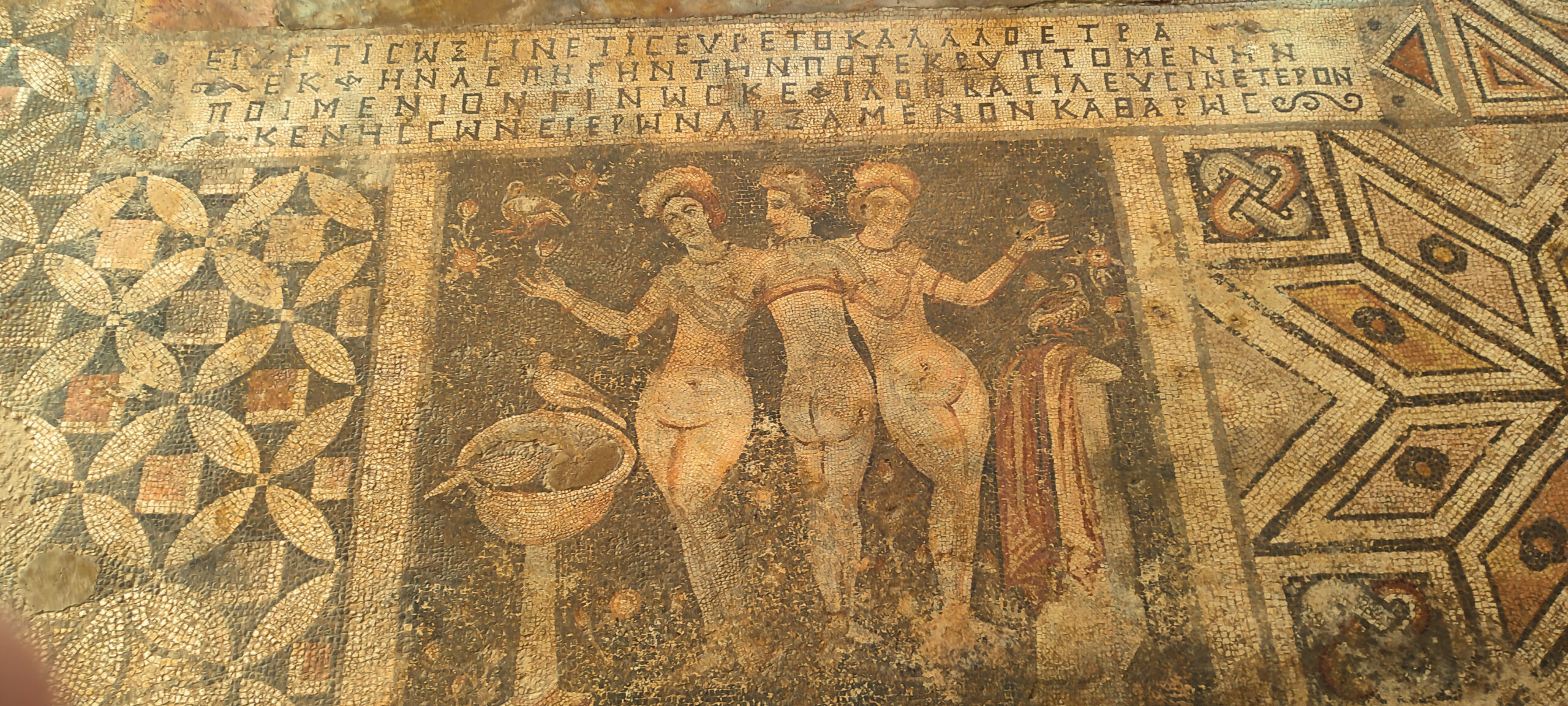
The mosaic.
Three naked figures are dancing. Black, white and yellow stone. No pathos, no gold. Just three bodies that have been moving for sixteen centuries without a single pause. You stand right above them, like a random observer in someone else’s simulation, and suddenly catch yourself thinking: they are not for you. They were here long before you learned to fear death. And they will be here when all that remains of you is a line in some cloud archive that will also be switched off one day.
You lean closer. The stone is cold. Like the water in the pool once was cold.
Matter and Myth
4th century. The Eastern Roman Empire is already rotting from the inside, but still pretends to be eternal. Some Poimenios — a governor, “friend of the emperors,” a rich functionary with a divine complex — decided to leave his mark.
Water. From a karst sinkhole in the Taurus Mountains, an icy freshwater river flows through underground pipes and bursts straight into the warm Mediterranean Sea. He caught this rare moment of mixing. He built a pool where salt and mountain freshness meet, and laid a mosaic on the bottom. The Three Graces. Aglaia, Euphrosyne, Thalia. Daughters of Zeus and the goddess of Harmony. A symbol that even in a dying world one can dance naked in cold water and feel like gods.
The material is ordinary local stone. The Romans knew how to turn what lies under their feet into luxury. And the myth is older than the gods themselves: Aphrodite was born from foam, the Graces are her eternal retinue. Here, in Narlıkuyu, everything came together perfectly: sea foam, underground cold, naked bodies and the illusion of eternity.
Eye of the Past
Imagine. Poimenios stands over the fresh pool on the day of opening. The slaves are still sweeping away the dust. The water is clear, like the promised future of the empire. He looks at the three dancing girls and thinks: “This is what I will leave behind.”
A hundred years pass — the empire cracks. A thousand years pass — new owners come, new gods, new wars. Earthquakes. Fires. Tourists with phones.
And the Three Graces keep dancing. They saw the last Roman official bathing in this water before fleeing. They saw the Byzantine monk baptizing himself in it. They saw the Turkish peasant in the twentieth century using the pool as a reservoir. They saw the German archaeologist in the seventies smoking over them and whispering “fucking beautiful”.
They saw everything. And said not a word.
Legacy in the Dust
This is not just an ancient mosaic. It is a quiet, cruel proof of concept.
We build rockets, neural networks, colonies on Mars — trying to hack the code of death. And a piece of floor laid by the hands of an unnamed slave under the supervision of a Roman bureaucrat has already outlived all of this.
This is the whole absurdity. Humanity is chasing immortality through technology, while real immortality lies at your feet in a concrete box on the Mediterranean coast and indifferently looks up with black-and-white eyes made of stone.
The Three Graces do not promise meaning. They simply exist. Like the Universe. Like you — for a few decades, if you’re lucky.
Poimenios thought he was buying eternity. He got it. Only not in the form he dreamed of.
How Did We Get Here?
Narlıkuyu, Silifke district, Mersin province, southern coast of Turkey.
From Antalya — about three hours along the coastal highway. From Mersin — about forty minutes. Look for the signs to the Cennet ve Cehennem caves (the Caves of Heaven and Hell) — the museum will be right along the way.
A small concrete building, the ticket costs pennies (sometimes it’s completely free). It’s better to come in the morning or closer to sunset, when there is less light and the mosaic becomes especially alive. Nearby is the same bay where the cold freshwater still bursts from under the rock into the sea. You can go in up to your ankles or plunge in completely.
Come alone. Without a guide. Without headphones. Just stand over the mosaic, look down and let it look at you.
It is already looking.
#VoiceOfRuins #ArtifactOfInevitability #MuseumOfOneExhibit #RomanRuins #ThreeGraces #Narlıkuyu #Mersin #Turkey #Meaninglessness #MemoryOfStone #GlanceThroughGlass


Our Telegram-channel: Voice Of Ruins https://t.me/Voice_Of_Ruins
Our Instagram: Voice Of Ruins https://www.instagram.com/voiceofruins/
Our group on Facebook: Voice Of Ruins https://www.facebook.com/share/g/16aitn9utM/
Our site: Voice Of Ruins https://www.voiceofruins.org



Leave a Reply