
Scars of History
Point of Ignition
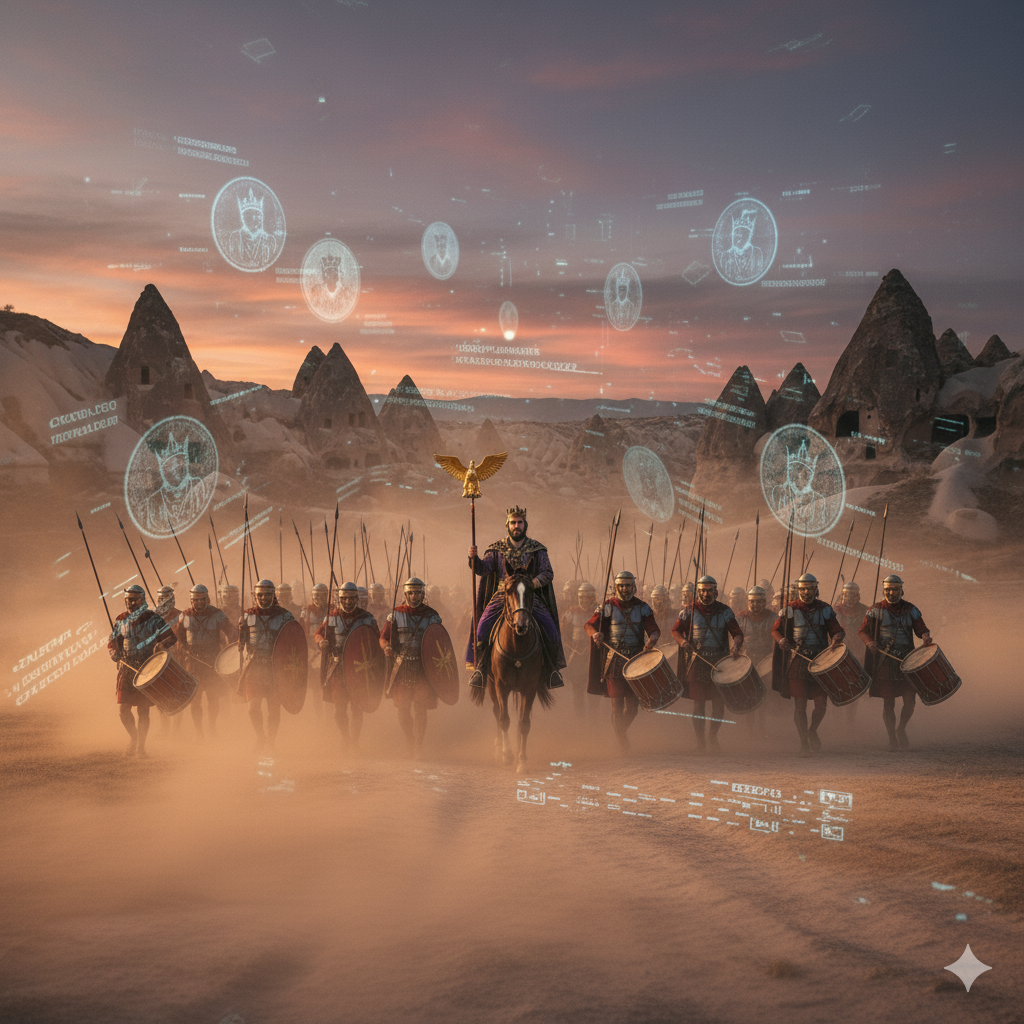
When power becomes a virus, the cure is sought not in the body, but in geography. Mithridates VI Eupator, king of Pontus, decided that Rome could be defeated not by the sword but by reflection.
He created a mirror empire — an anti-Rome, an eastern version of order where everything was meant to obey his will. And his first test subject was Cappadocia — a land of mountains, ash, and trembling thrones.
After the death of Ariarathes VI, a quiet apocalypse began here: every new ruler was not a man, but an update of the system. Ariarathes VII, VIII, IX — not names, but versions of the same program Mithridates kept rebooting, trying to erase the bugs of history.
But when you play god, even Rome starts to see you as a virus.
Chronicle of Collapse
Cappadocia — the heart of Anatolia, crossroads between the Black Sea and Syrian dust. After Ariarathes VI died (around 116 BC), the throne stood empty.
Mithridates, whose sister Laodice was the late king’s widow, saw an opening. He placed the young Ariarathes VII — his nephew — on the throne. Officially, a rightful heir; in reality, a puppet in the laboratory of power.
But experiments don’t age well. When the boy tried to act like a real king, Mithridates deleted the error. He replaced him with new versions — Ariarathes VIII, then IX, possibly Mithridates’ own son disguised as a legitimate successor.
The Cappadocian nobility murmured, and Roman senators grew uneasy. The Empire in the West could not allow the key to the East to fall into the hands of a king dreaming of a counter-empire. Rome sent a “patch” — a new king, Ariobarzanes, and legions to restore system control.
Mithridates responded symmetrically: his ally Tigranes II of Armenia invaded Cappadocia, sweeping away Rome’s guarantees like dust off marble. On the land where altars had stood for centuries, now landed the principles of geopolitics.
Cappadocia turned into a testing ground — where rulers changed as often as the locks’ codes.
Ruins of Decisions
Rome won — but only for a while.
Mithridates retreated but left behind an infection — the idea that power can be engineered. When the Mithridatic Wars erupted years later, that virus spread across Asia Minor.
Cappadocia became what every laboratory becomes after an explosion: a source of ideological radiation. Every new eastern monarch now knew he could be a puppet and still pull the strings himself.
Rome learned that control isn’t ownership — it’s the constant fear of losing it. From then on, the East was not a territory but a symptom.
Shadows at the Edge of Reason
In every empire, someone eventually starts playing god.
Mithridates invented an antidote to obedience — he wanted to make people immune to Rome, like to a poison. But the paradox is that, while defending against power, he became its most toxic form.
Rome saw a monster. The East saw a savior. History sees a scientist without ethics, dissecting the living body of a region to test how much interference it could endure.
The answer was predictable: the fabric of power tears, but keeps breathing. And now, looking at the ruins of Cappadocia, you can still hear the echoes of that first mutation — when control turned into religion.
How Did We Get Here
Cappadocia hasn’t forgotten the experiment. The valleys of Göreme, underground cities, and charred cliffs of Selime all feel like extensions of the same code. The world here is carved not only in stone but in the fear of control.
You can reach it from Nevşehir or Kayseri — along roads laid over the bones of the old Ariarathid highways. In the Kayseri Museum, you can still find Pontic coins where Mithridates’ face stares back at you from a mosaic mirror.
If you linger among the ruins of Kayseri (ancient Mazaka, Cappadocia’s capital), you may feel a strange pressure — as if time itself is waiting for someone to rewrite the throne again.
Echo in the Void
I stood in the wind, and the air smelled not of dust but of memory. The idea still lives here — that power is a form of fear, just well-edited.
Cappadocia is not a landscape but a manual on how control collapses when touched by human hands.
Mithridates wanted the East to become its own immunity. But immunity easily turns into autoimmunity.
And if you listen carefully between the rocks, you can hear a sound — as if someone is starting the experiment all over again.
#VoiceOfRuins #ScarsOfHistory #Mithridates #Cappadocia #Pontus #Rome #Antiquity #HistoryOfPower #Empires #Armenia #EastVsWest


Our Telegram-channel: Voice Of Ruins https://t.me/Voice_Of_Ruins
Our Instagram: Voice Of Ruins https://www.instagram.com/voiceofruins/
Our group on Facebook: Voice Of Ruins https://www.facebook.com/share/g/16aitn9utM/
Our site: Voice Of Ruins https://www.voiceofruins.org




Leave a Reply