
Scars of History
Ignition Point
There are wars that begin over territory. There are wars over gods.
And then there are wars born from human ego.
53 BC. Somewhere between the deserts of Mesopotamia and the dusty roads of Syria, a Roman army slowly turns into meat.
At the head of that army stands a man who could buy half the world. His name is Marcus Licinius Crassus. The richest man in Rome.
He financed wars, bought houses after fires, lent money to senators and generals. He could buy a city faster than a legion could capture it.
But money has an unpleasant property: it does not leave glory behind.
Glory belongs to those who die beautifully.
So Crassus decided to purchase himself a place in history. He marched to war against the Parthian Empire.
History responded in kind. And sent him the bill.
Chronicle of Collapse
The event — The Battle of Carrhae.
The setting — the plains near the city of Carrhae.
Crassus commanded around 40,000 legionaries. Heavy infantry, discipline, machines of war that had ground half the Mediterranean world into dust.
The Parthians had far fewer men. Their army was led by the general Surena.
But they had different weapons. Horses. Bows. And patience.
Parthian horse archers move around the Roman army like a flock of birds. They do not attack. They shoot.
Arrows fall on the legions like iron rain. The Romans wait for the enemy to run out of ammunition. But behind the hills stand caravans of camels. The camels carry mountains of arrows.
Each arrow is a small financial report for Crassus.
Panic begins when Crassus’s son enters the fight — Publius Crassus.
The Parthians do what steppe armies do best: they pretend to retreat.
He pursues them. A few kilometers later his force is surrounded. The cavalry is annihilated. Publius’s head is raised on a spear and shown to the Roman army.
At that moment the soldiers understand: they are inside a perfect trap.
By evening the field is covered in bodies. Around 30,000 Roman soldiers remain lying in the sand.
Gold
The next day Crassus tries to negotiate.
But the negotiations end very badly. A fight breaks out. Crassus was killed.
And then the legend begins.
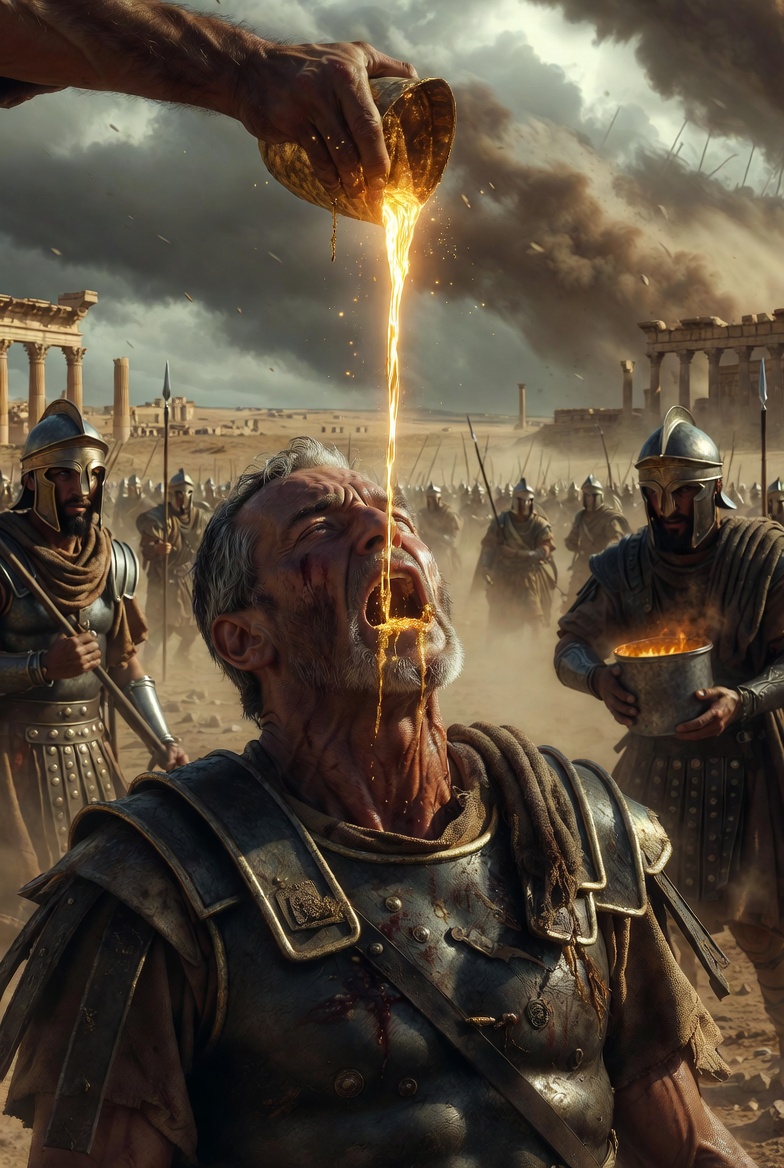
According to one story, the Parthians performed a symbolic operation on the body of the richest man in Rome.
They poured molten gold into his mouth.
The message was simple: You wanted gold. Here it is.
Historians debate whether this actually happened. But sometimes a legend is more accurate than a fact. Especially when it sounds like the perfect epilogue to human greed.
The Lost Legion
After the battle about 10,000 Roman soldiers were captured.
The Parthians did not kill them. Empires rarely waste useful resources.
The prisoners were sent far to the east — to the frontier of the empire, into the steppes of Central Asia.
Almost twenty years pass. And suddenly Chinese chronicles record something strange.
General Chen Tang fights a battle against nomads.
Among the enemy the Chinese notice soldiers who fight in an unusual way: they form a dense rectangular wall of shields, like fish scales. It resembles the Roman testudo formation.
Some historians later suggested that these might have been Crassus’s captured legionaries, who had traveled across the steppes and eventually ended up on the edge of China.
In the Chinese province of Gansu there is even a village called Liqian, where some inhabitants are said to have light eyes and an unusual story of origin.
There is almost no proof. But the idea survives. Somewhere on the edge of ancient China there might once have been a Roman garrison that forgot where Rome was.
Ruins of Decisions
The Battle of Carrhae became one of Rome’s most expensive mistakes.
It destroyed the political balance inside the Republic.
Without Marcus Licinius Crassus, the third pillar of power between Julius Caesar and Gnaeus Pompey the Great disappeared.
Within a few years they would begin a civil war. The Republic would die. In its place the Empire would rise.
Sometimes a single battle in the desert is enough to change the architecture of history.
Shadows at the Edge of Reason
History loves paradoxes.
The richest man in Rome dies in a desert. An army that conquered half the world loses to horsemen with bows. Legionaries may end their lives on the border of China.
Empires build roads to move forward.
But sometimes the road suddenly ends in sand.
And then something simple becomes visible: civilizations do not fall because of enemies. They fall because of human ambitions that want to become immortal.
How Did We Get Here?
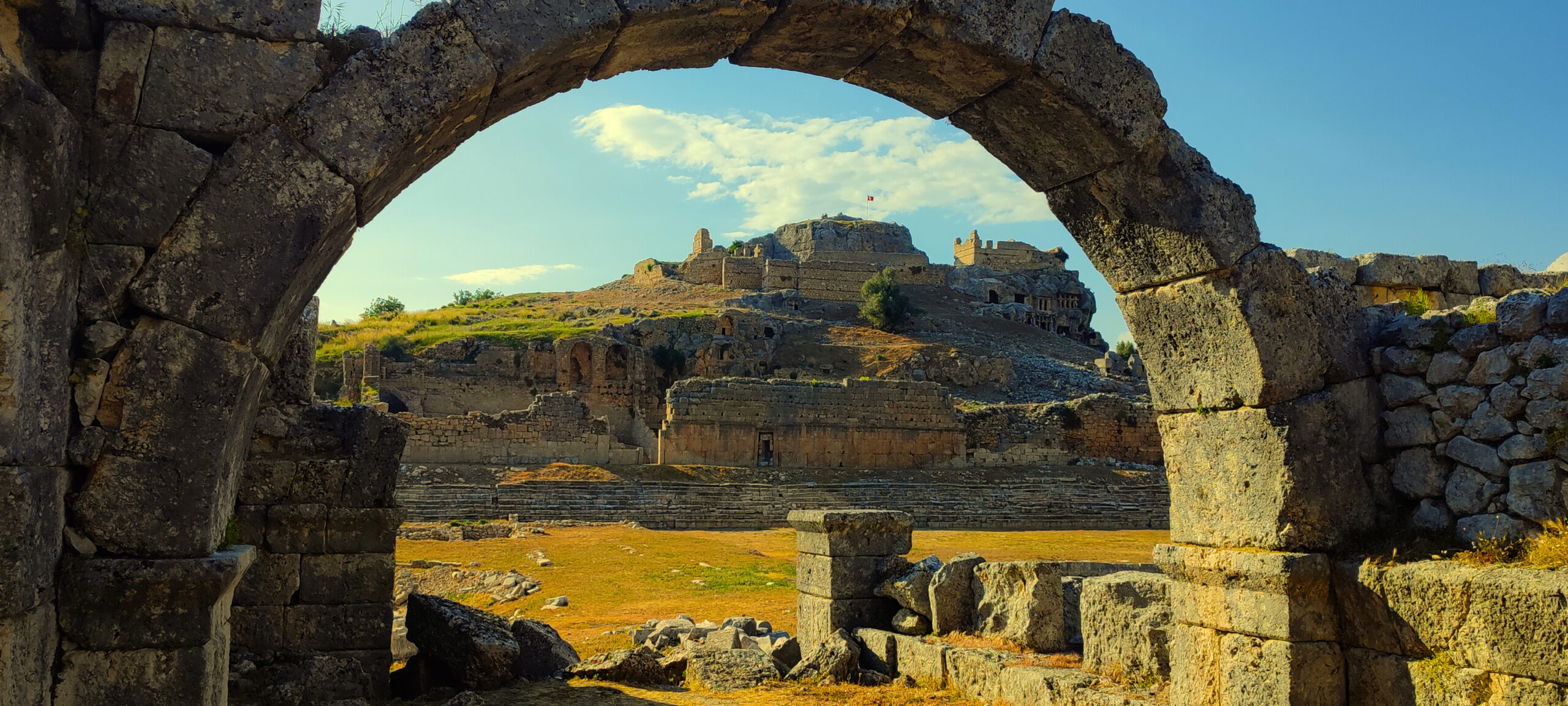
Today the battlefield lies near the Turkish town of Harran.
The landscape has barely changed: a plain, dust, wind, ancient ruins.
Nearby you can still find: the remains of ancient Carrhae, the walls of Harran, roads of ancient Mesopotamia.
The place looks almost empty.
But if you stand there in the evening, it is easy to imagine the sound of arrows striking Roman shields.
Echo in the Void
There is a strange feeling that appears in places like this.
You realize that history is not a textbook.
It is a field where thirty thousand bodies once lay.
Where the richest man of his time discovered that money cannot buy the outcome of a battle.
And where perhaps began the journey of legionaries who could walk thousands of kilometers and end their lives on the other side of the world.
Sometimes history feels like a giant machine of coincidences.
But sometimes it looks like a perfectly written tragedy.
Too precise to be accidental. Too absurd to be logical.
And somewhere inside it there is still a quiet metallic sound. As if someone were pouring gold into the mouth of a dead republic.
#VoiceOfRuins #ScarsOfHistory #Carrhae #BattleOfCarrhae #MarcusLiciniusCrassus #AncientRome #Parthia #Harran #History #FallOfTheRepublic #Legions #LostLegion #Liqian #AncientChina #Antiquity


Our Telegram-channel: Voice Of Ruins https://t.me/Voice_Of_Ruins
Our Instagram: Voice Of Ruins https://www.instagram.com/voiceofruins/
Our group on Facebook: Voice Of Ruins https://www.facebook.com/share/g/16aitn9utM/
Our site: Voice Of Ruins https://www.voiceofruins.org



Leave a Reply