
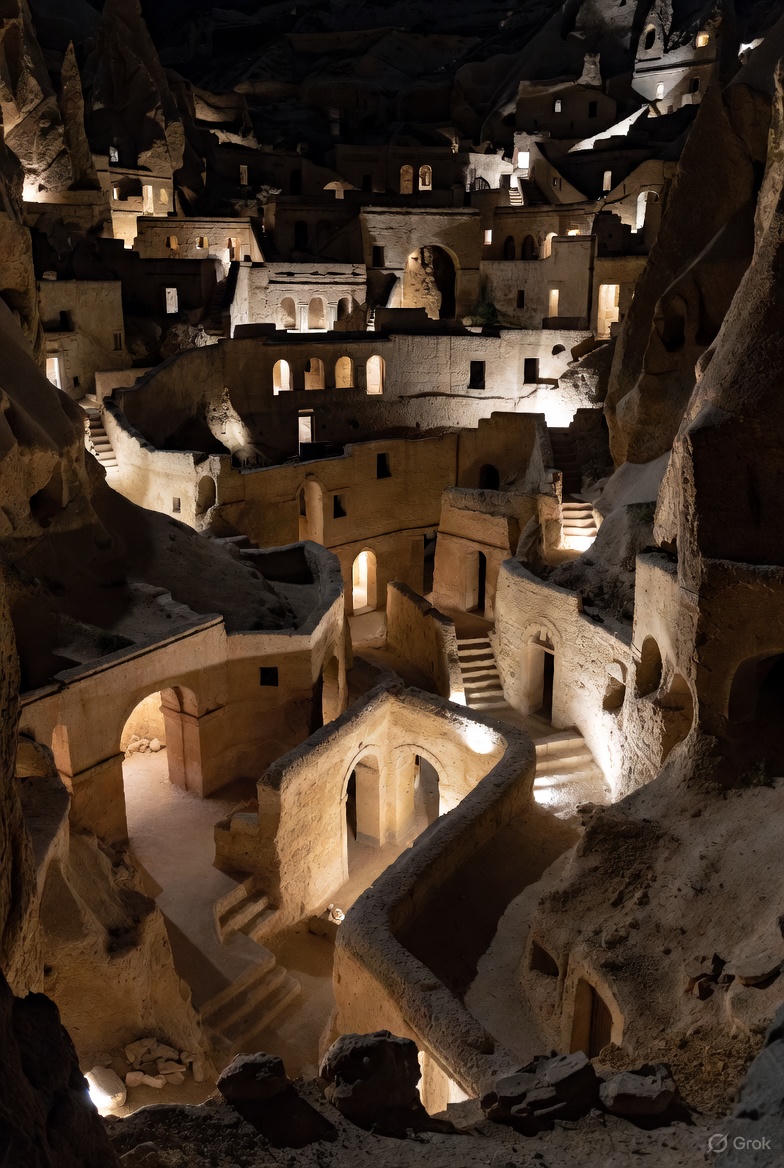
Ravings at the Edge of Time
Versions of the Non-Existent
Some cities grow into the sky. Some dissolve into the desert.
And then there is Derinkuyu — the city that stepped downward to survive, and accidentally found a door into the future.
They say underground cities live longer than surface ones. Because the wind doesn’t grind them down to the bone, because memory doesn’t evaporate there — it condenses as moisture on the ceilings of the corridors.
But in our version, Derinkuyu did more than just “survive”: it continued.
We didn’t develop it — it developed us. Step by step, level by level, to where the air becomes quieter and the thoughts louder.
And when the archaeologists of the future descend into these clusters, they won’t understand the main thing: Derinkuyu isn’t ancient. It’s simply unfinished.
Worlds That Never Were
1. When the City Decided It Had Waited Long Enough
In this alternate timeline, everything went off the rails. In the 18th century, Derinkuyu accidentally switched on.
The cause wasn’t a mystical portal, or solar radiation, or a meteor strike, as pseudo-historians love to claim. It was simpler.
A micro-fault triggered by a small earthquake disrupted the old ventilation shafts. The drafts formed a kind of wind-organ, and the city hummed.
People decided it was a ghost. The city decided it was time to evolve.
Humidity rose, new forms of bacteria appeared — the first intelligent utility engineers. They began reinforcing the vaults by mineralizing them, forming layers that no tool could split.
The city stopped being a ruin and became a bio-engineered project concerned with its own health.
2. And Then Came Those Who Were Ready to Listen
In the 19th century, the Ottomans discovered that the underground tunnels had expanded by eleven new levels. Engineers tried to explain this with geology, but no one could understand where the perfectly symmetrical, rail-sized tunnels had come from.
Legend says one engineer muttered: “This city builds itself faster than we build roads.”
Thus began the era of Subterranean Modernity.
Derinkuyu transformed into:
a research station, studying self-growing structures;
a refuge, where elites built backup apartments for the next war;
a laboratory, testing autonomous ventilation systems that would later inspire the first Martian bases;
a cult center, visited by those who believed the city could hear thoughts.
Strangely enough, the last one was partially true — the walls reacted to sound and vibration, and if you spoke long enough, the vault began to shift, adjusting to the voice.
People called it subterranean neuroplasticity.
Phantom Architectures
1. “Derinkuyu 9.0: The Lower Tier”
A tunnel with organic walls resembling crystallized tuff; glowing ventilation lines branching like roots; suspended platforms carrying silent moving capsules.
2. “The Subterranean Consortium: Central Dome”
A massive hall shaped like a heart. Columns resembling giant arteries. People — tiny figures moving along transparent bridges.
3. “The Tunnel Into Tomorrow”
A narrowing corridor lit by soft bioluminescent light. In the distance — a silhouette entering what looks like another temporal layer.
4. “The Cybernetic Chapel”
A prayer room where the walls pulse faint light — as if reacting to the breath of those who enter.
Reality Is Blurred
Scientific facts blend with our fantasy in eerie harmony.
Fact: Derinkuyu is a multi-level underground city, 60 meters deep, designed for tens of thousands.
Fiction: It is still expanding.
Fact: Its ventilation system is so advanced it seems impossible for its era.
Fiction: It works like the respiratory system of a living organism, adjusting itself to the number of people.
Fact: Some levels look as if they weren’t made by humans — perfect circular openings, strange widenings.
Fiction: They really weren’t made by humans.
So where is the boundary?
When you go down, the lamps give just enough light to see reality — and doubt it. As if the city is playing with you: showing truth to hide fiction, or showing fiction to hide truth.
Echo in the Void
When I stood in one of the future corridors of Derinkuyu — only in my mind, of course — I realized one thing: underground cities aren’t attempts to hide. They’re attempts to go deeper into oneself.
Downward means inward. Depth isn’t measured in meters; it’s a process.
And if Derinkuyu had never stopped, if its evolution hadn’t been interrupted by wars, religions, states, bureaucracy — humanity might have chosen a different vertical direction.
Not upward, but downward. A world not of skyscrapers but of sub-earth layers.
Where floors aren’t classes, but stages of self-analysis. Where light isn’t from lamps but from decisions. Where each new corridor is a future we have just begun to dig.
An underground city as a metaphor for a civilization unafraid of darkness because it carries its own light.
And yes — sometimes it feels right to believe that dozens of meters below, where silence becomes tangible, Derinkuyu truly continues to grow.
Slowly. Calmly. Steadily.
As if it knows the direction better than we do.
#voiceofruins, #deliriumsattheedgeoftime, #derinkuyu, #undergroundcity, #cappadocia, #alternatehistory, #imaginedpast, #ai-visualization, #mystifications, #thefuturethatneverwas


Our Telegram-channel: Voice Of Ruins https://t.me/Voice_Of_Ruins
Our Instagram: Voice Of Ruins https://www.instagram.com/voiceofruins/
Our group on Facebook: Voice Of Ruins https://www.facebook.com/share/g/16aitn9utM/
Our site: Voice Of Ruins https://www.voiceofruins.org




Leave a Reply