
Call of the Void
Point of Disappearance
Emptiness here isn’t an absence. It’s a process.
You take just one step into the Ihlara Valley, and it’s already decrypting you — as if it were scanning not your body but the background processes of your consciousness. The faint echo under your feet reminds you: you’re not a traveler, just a temporary guest in someone else’s algorithm.
The wind moves through the canyon as if it carries an ancient code written long before humans appeared. And somewhere in that code is a line about disappearance — one that executes only when you show up. So you quietly vanish: first from the noise, then from your usual mental patterns, then from yourself altogether.
Ihlara doesn’t ask for permission. It just begins.
Landscapes Without Hope
The trail through the canyon follows the Melendiz River, as if someone dragged a wet finger across stone and left a 14-kilometer mark. The cliffs around you are vertical archives of geological epochs, stacked without any right to edit.
You walk between them and realize this landscape wasn’t designed for humans: the paths are too narrow, the sky is too low, and there’s too much light falling at the wrong angle — as if the world is slightly misconfigured.
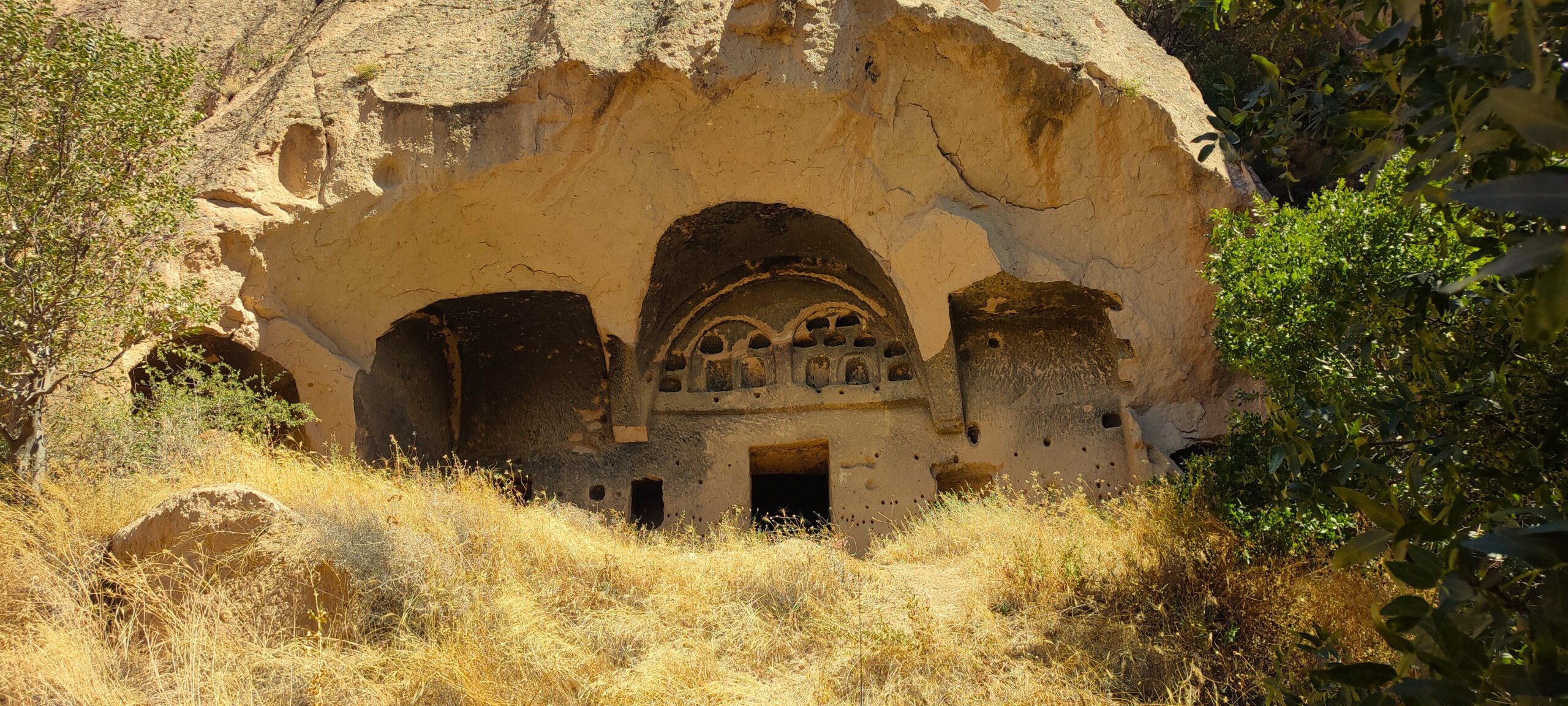
Along the way you pass cave churches whose pigments have long washed out to the state of “unreadable symbols.” The stone walls still hold the breath of those who fled here seeking silence — and stayed in it forever.
Through the thick green branches you see splinters of old mills, bridges, and trails that lead nowhere. Ihlara doesn’t build routes — it only pretends they exist.
The Cry of Stones
At some point the silence becomes dense, like firmware. You stop hearing yourself — and start hearing the stones. Not in any mystical sense, but in that strange way the mind works when it stops receiving the noise of civilization and switches to a fallback perception mode.
This “cry” isn’t pain. It’s the stones reminding you they existed before you and will exist after — and that your presence here changes nothing in the configuration of the world.
The river splashes as if mocking any attempt to find something elevated in this place. Birds fly at altitudes inaccessible to your logic. The canyon lives by its own rules and allows you to observe, but not interfere.
You feel unnecessary — and strangely, that brings relief.
Shadows on the Edge of the Mind
Here it’s easy to think about things you usually run from. About how much of your life is interfaces, and how little of it is direct contact with reality. About how solitude isn’t an enemy but a hidden feature we’re afraid to activate.
Ihlara seems to say: “You are a temporary bug of consciousness trying to explain the architecture of an eternal system.”
And in those shadows cast by the canyon walls, it sometimes feels like you see your own shape — not the body, but the configuration of fears, hopes, and stray memories that keep your system assembled.
There is no mysticism here. But the mind insists there’s more than enough of it.
Marks on the Map
The route through Ihlara is simple, unless you complicate it with your expectations.
— Entrances: the main one at Ihlara village, an alternative at Belisırma, but the best start is from Selime.
— Total length: around 14 km, but you can walk it in segments.
— Ancient churches appear every 10–20 minutes if you don’t wander off.
— The river never runs out — it operates in a “perpetual reboot” mode.
— Shade is always available, which matters in summer.
— Food: in Belisırma you can sit on platforms right over the water and eat as if participating in a simulation of relaxation.
The difficulty is moderate: you think more than you get tired.
Echo in the Void
When you exit the canyon, it feels like someone removed an unnecessary module from you — something heavy that used to make noise and now is silent.
Ihlara isn’t a place of power. It’s a place of verification. It doesn’t give answers — it shows that most of your questions were redundant.
You leave, but the sense of emptiness follows you for a long time — like an update the system installs without your consent.
#GolosRuin, #DustOfAges, #Ihlara, #Cappadocia, #canyons, #hikingtrails, #ancientchurches, #ecopaths, #cavemonasteries, #emptiness, #solitude, #geology, #travel


Our Telegram-channel: Voice Of Ruins https://t.me/Voice_Of_Ruins
Our Instagram: Voice Of Ruins https://www.instagram.com/voiceofruins/
Our group on Facebook: Voice Of Ruins https://www.facebook.com/share/g/16aitn9utM/
Our site: Voice Of Ruins https://www.voiceofruins.org




Leave a Reply