
Call of the Void
Point of Disappearance
There are fractures in geography, and there are fractures in the mind. Ihlara is a rare place where one passes through the other, like a needle through fabric.
Here, you don’t start a route — you’re lifted out of your habitual reality and placed into a space that has long remembered you as someone weaker, more honest, less assembled than you pretend to be now.
You take your first step into the canyon — and the air seems to inhale slightly. As if checking: Are you the same? The one who once came here long ago — or someone new, carrying the same cracks?
Your steps soften, your voice quiets, your thoughts become malleable. It isn’t fear. It feels as if you’re being gently shifted from the world of probabilities into the world of inevitabilities.
Landscapes Without Hope
The canyon doesn’t describe space — it dictates it. The cliffs stand not like walls, but like fragments of a vast, almost living mechanism that once turned and in its turning created time.
Now it has stopped. But the echoes of movement are still there — if you listen between your own heartbeats.
The Melendiz River is too calm to be mere water. Sometimes it seems to flow not downward but in circles, as though trying to keep something trapped within the canyon.
The vegetation on the banks feels dense not from moisture but from the sense that it hides traces — not of humans, not of animals, but of the geography itself trying to erase its own scars.
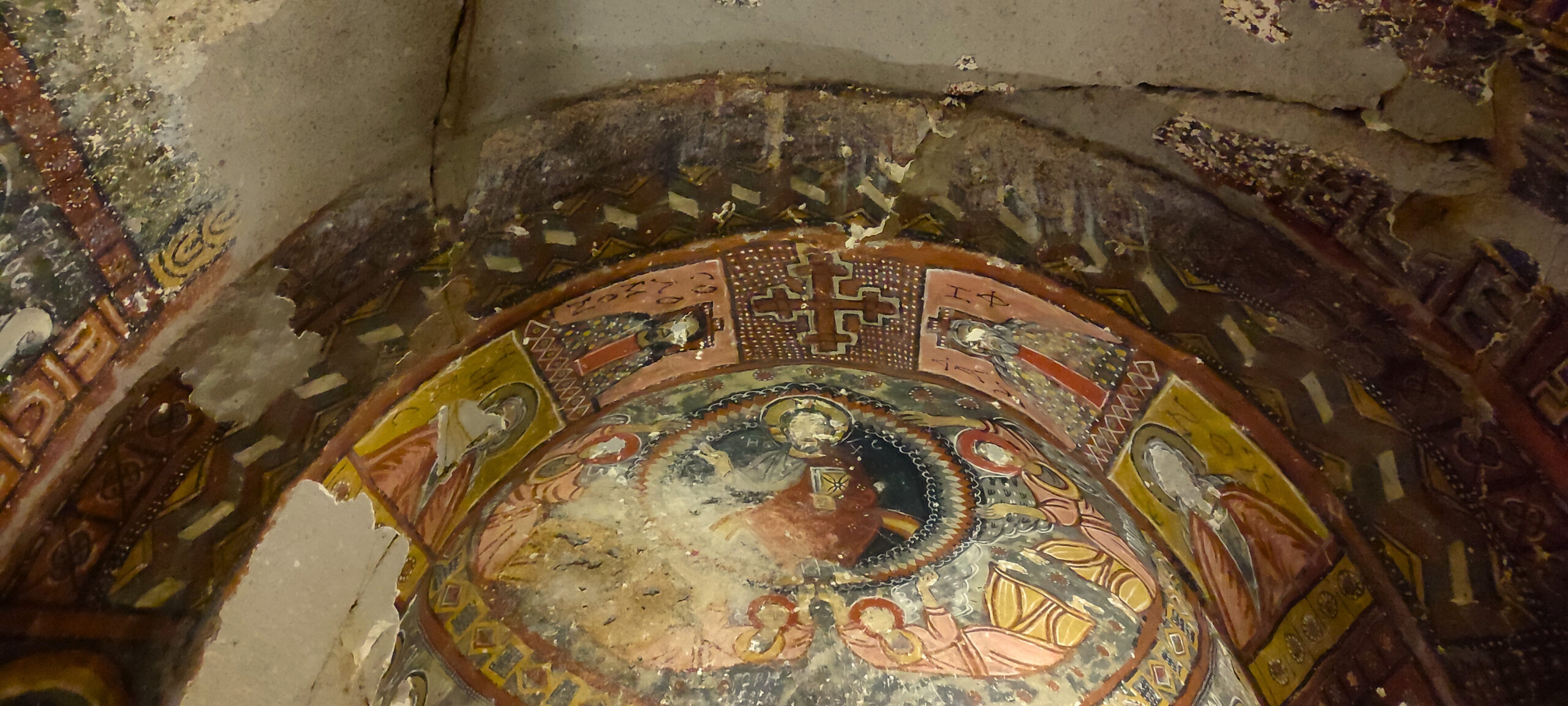
Rock-cut churches appear like pauses in a conversation where the speaker suddenly falls silent. The frescoes have lost their faces — only hints of what they once were remain.
But if you linger a moment longer than comfort allows, the lines begin to surface slowly. Not for you — for themselves. To remember.
Cry of the Stones
There is a sound one can hear only in someone else’s dream. That is how Ihlara’s stones speak.
Sometimes the canyon releases a deep, almost underwater hum — as if something enormous is taking a breath beneath the earth. Others would say, “wind.” But you feel it: the wind here is only a courier.
The rocks converse with one another. Discuss directions. Compare those who returned to those who left. Sometimes they fall silent — and within that silence lies a question you try not to understand.
Birds, sensing these shifts, fly at a height that suggests they’re avoiding not physical danger but an unwanted attention. The water makes tiny zigzags, like an animal frightened by something unseen.
And all the while, that faint prickling on your skin — as if the space itself is touching you with its fingertips.
Shadows at the Edge of Reason
When the sun gets caught between the rocks, the shadows stretch longer than geometry should permit. They detach from the walls too early. Cling to the ground too late.
At some point you realize you’re guarding your own gaze — focusing only on the trail, the river, the sky. Because something feels as though it stands beside you, slightly behind. Not watching. Not frightening. Just present.
The silence here speaks. It asks questions but so gently that answers appear on their own — usually the wrong ones.
There is no threat in this. There is a process: as if the canyon is not trying to know you. It’s trying to remember you.
Tracks on the Map
— Start closer to the canyon’s beginning: there, it has not yet decided whether you belong to it.
— The route spans about 14 km, but your steps feel longer than they should.
— The river is the only constant. Everything else shifts like weathered moods.
— The rock-cut churches aren’t points of interest — they’re pauses of breath.
— In Belisırma, time flows slower, and sometimes you suspect it’s you holding the world still, not the other way around.
— The physical difficulty is moderate, but the psychogeography is heavier than confident hikers expect.
Echo in the Void
As you exit the canyon, you hear something like a second step — not yours. Silence catches up to you. Not threatening — reminding: “You left something here. And something came with you.”
And you understand: Ihlara doesn’t let you go. It unlocks — like a door you try to close, only to notice the handle turn on its own. You will leave. But not completely.
The void will keep your name. Until you hear its call again.


Our Telegram-channel: Voice Of Ruins https://t.me/Voice_Of_Ruins
Our Instagram: Voice Of Ruins https://www.instagram.com/voiceofruins/
Our group on Facebook: Voice Of Ruins https://www.facebook.com/share/g/16aitn9utM/
Our site: Voice Of Ruins https://www.voiceofruins.org




Leave a Reply