
Calendar of Oblivion
Gates of Time
There are days that look like a date. And there are days that behave like a system glitch. December 25 is the latter.
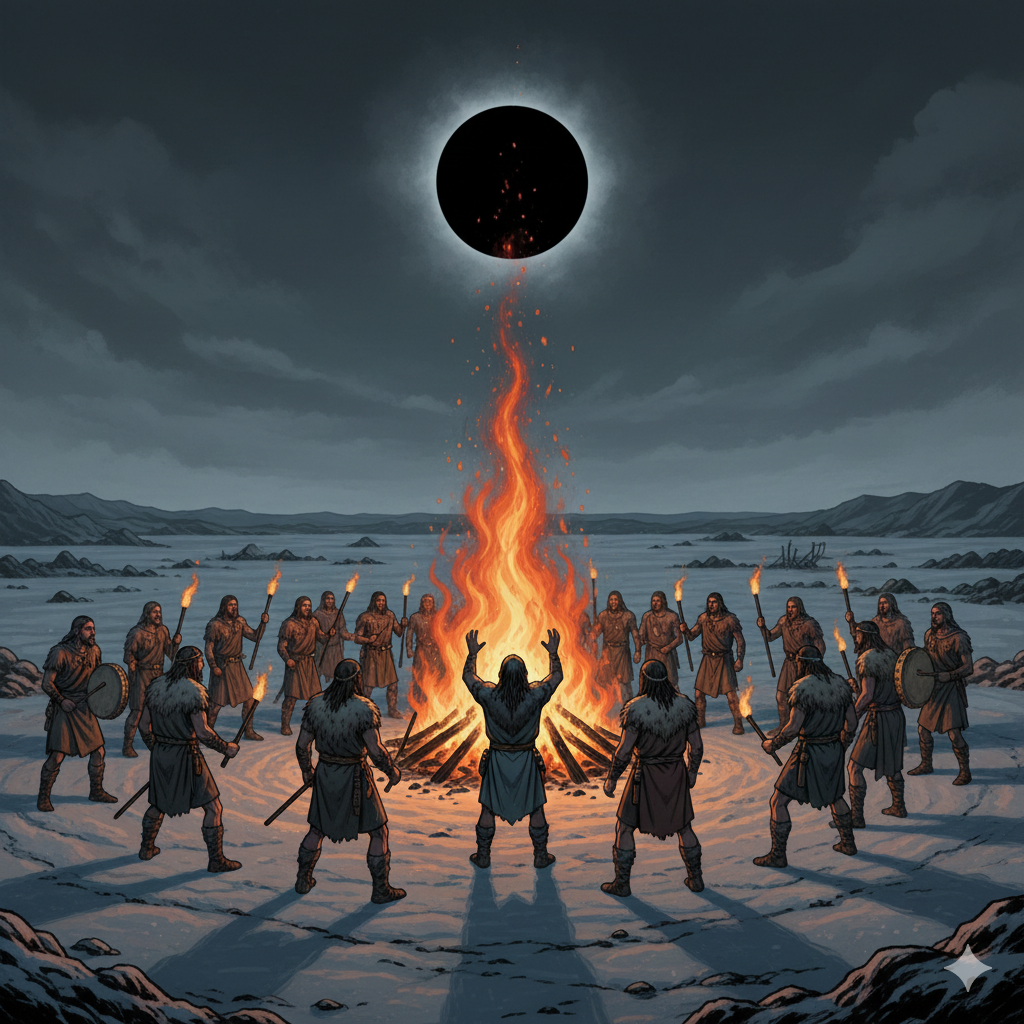
This is the moment when reality wobbles slightly, like a poorly secured stage set. The sun stops declining. Darkness reaches its limit. The universe pauses—exactly for three days. The ancients did not see this as astronomy, but as drama: the light has died, lies motionless, not breathing, and no one is sure it will return.
That is why the celebration does not begin with joy. It begins with anxiety. With a bonfire. With blood. With wine. With an attempt to persuade the world to keep going.
This day was not invented—it was extracted from the experience of survival. It emerged where winter killed slowly, and the calendar was a matter of life and death.
Feast Behind the Black Veil
They celebrated as if tomorrow might not come.
In Rome—Saturnalia: social order was temporarily suspended. Slaves ate at their masters’ tables; power passed to masks and laughter. It was controlled chaos—so that chaos would not become permanent.
In the cult of Sol Invictus, the sun was honored as a soldier who had survived defeat and risen again. The sacrifices were symbolic—but the fear was real.
In the North, Yule logs were burned; people drank to oblivion and watched fire slowly consume wood—a rehearsal of what winter does to bodies.
Some fasted; others fell into ecstasy. Somewhere animals were sacrificed; elsewhere—the remnants of common sense. Fermented drinks, smoke, dances, rhythms that destabilized perception were all put to use.
Humans have always wanted to rewrite the physics of the world. At least for a day. At least to pretend the laws were suspended.
Gods Among Us
Formally, this is a festival of the sun. In reality, it is a festival of the presence of something—anything.
Among the Romans—the Invincible Sun. Among the Iranians—light passing through darkness. Among the Egyptians—a solar deity that dies and is reborn every night. Among northern peoples—fire itself as a living being.
Later, new meanings, new names, new myths were carefully laid over this. But the mechanism remained the same: the world must be dedicated to someone, otherwise it looks terrifyingly empty.
A festival is a way to say: someone is with us. Even if it’s just a calendar that needed to be filled with something.
Shadows at the Edge of Reason
Festivals are needed not because life has meaning, but because it loses it too often.
Ritual creates the illusion of order: repeat the gestures of the ancestors and the universe will not fall apart. Light a fire on the right day—and the sun will return. Drink, sing, put on a mask—and death will step back a little.
Sometimes it works. Sometimes it doesn’t. But without ritual, all that remains is the emptiness of the calendar and identical days, unprotected from dread.
A festival is a collective hallucination. But a hallucination on which civilizations were built.
How Did We Get Here?
In modern terms, this is the period after the winter solstice—December 21–22. Those very three days when the sun “stands still.” And on the 25th—it begins to return.
Today this is reconstructed through festivals, museums, historical parks, neo-pagan gatherings, and city celebrations that pretend it’s just an excuse for garlands.
If you happen to end up at a modern Saturnalia Fest:
don’t argue about meanings—there are none there,
don’t drink everything—traditions survived centuries; your liver won’t,
remember that you’re inside a simulation of ancient fear.
Echo in the Void
I experienced this day without altars or sacrifices. Without gods. Almost without faith.
More like an observer standing backstage in a theater where the actors died long ago, but the lines are still being spoken.
And yet—at this moment, a shift is felt. The day grows longer. Light lingers on the skin. Something minimal, but objectively real, changes.
The sun does not win. It simply returns.
And that is enough to once again pretend that the story continues.
#VoiceOfRuins #CalendarOfOblivion #BirthdayOfTheSun #WinterSolstice #SolInvictus #Saturnalia #Yule #AncientFestivals #RitualsAndMysteries #SolarCult #MythologyOfLight #PhilosophyOfCelebration #RitualAndDeath


Our Telegram-channel: Voice Of Ruins https://t.me/Voice_Of_Ruins
Our Instagram: Voice Of Ruins https://www.instagram.com/voiceofruins/
Our group on Facebook: Voice Of Ruins https://www.facebook.com/share/g/16aitn9utM/
Our site: Voice Of Ruins https://www.voiceofruins.org
More Points On The Map




Leave a Reply