
Dust of Time
Entrance to the Labyrinth
There are places you don’t come to — you end up there. The Kizilkoyun Necropolis doesn’t call tourists, doesn’t flash signposts, and doesn’t sell skull-shaped magnets. It simply exists. Like an error in the landscape. Like a reminder that death was once infrastructure, not an event.
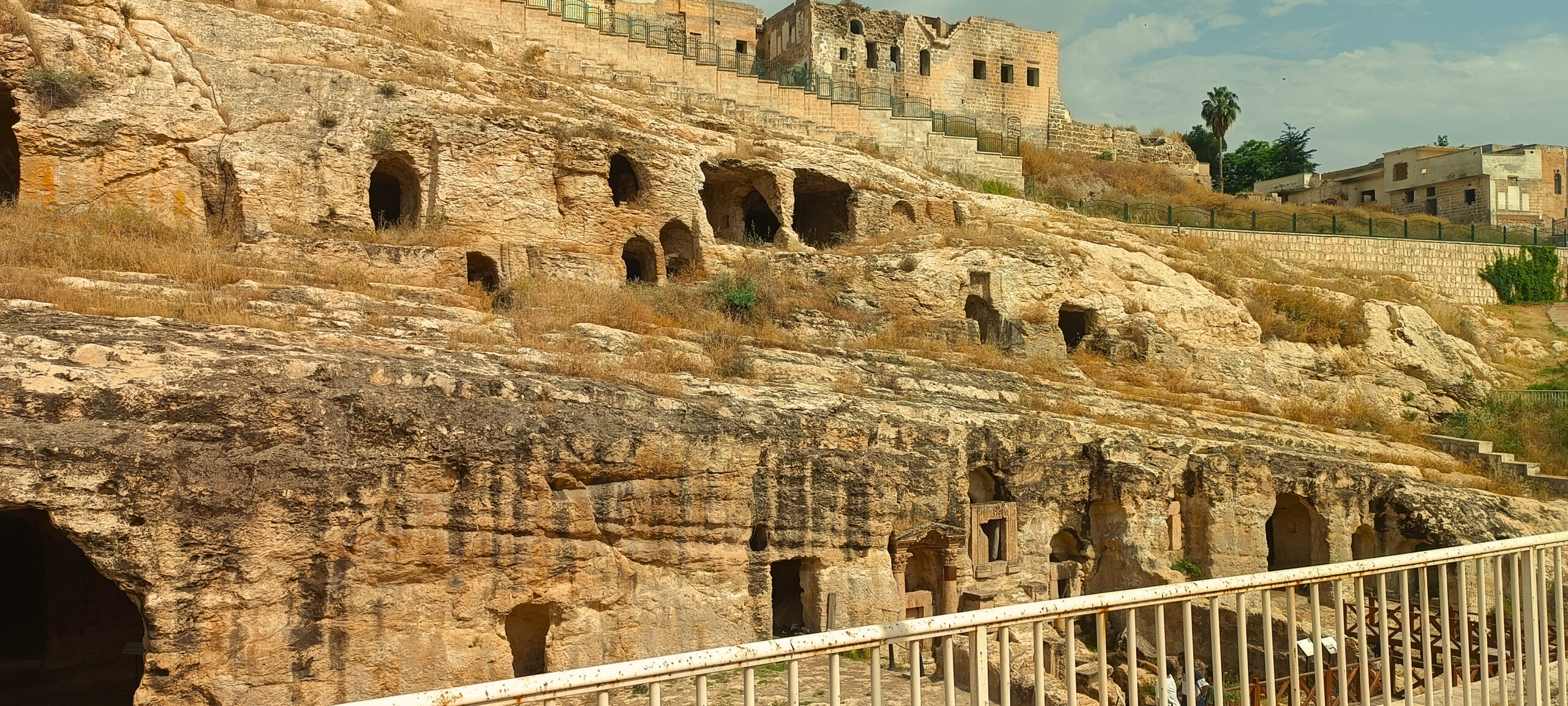
You walk along an ordinary street in Şanlıurfa — concrete, cars, palm trees, vendors. And then the city glitches. Phantom faces emerge in the rock. Rectangular voids. Stone doors behind which no one has been waiting for a long time, yet someone is still watching.
Kizilkoyun doesn’t scare you. It records you.
Past the Empires
This necropolis is older than most explanations we try to bolt onto it. The main body of the tombs is dated to the Hellenistic and Roman periods, but the logic of the place itself predates any empire.
The cliffs here are soft limestone — an ideal material for those who wanted to carve eternity quickly and in bulk.
Kizilkoyun is not a collection of individual burials; it is a system. Hundreds of rock-cut tombs arranged in tiers, like an archive of bodies. Stone façades with pediments, columns, false doors. Everything as with the living — except without a future.
Empires changed. The Romans arrived and added order. Byzantium arrived and added crosses. Islam arrived and added silence.
And the rock remained. Because geology does not participate in ideology.
Fragments of the Present
Today, Kizilkoyun is a strange hybrid: an archaeological site, a residential neighborhood, and a cultural malfunction. Some tombs have been cleared and conserved. Others are embedded directly into the modern city. Balconies face sarcophagi. Children play at the entrances to rock chambers. Chickens peck at dust that is two thousand years old.
This is not a museum in the usual sense. There is no feeling of completion here. No final route. You constantly sense that the necropolis is not finished — it has merely been paused.
Kizilkoyun is not the past. It is a process.
Shadows at the Edge of the Mind
The main effect of this place is the gaze. The tombs are carved in such a way that they resemble faces. Empty niches function as eyes. And you catch yourself thinking that it’s not you examining the necropolis — it is scanning you. Perhaps it is considering whether you will be buried inside, or simply pass by.
This is not mysticism head-on. It is silence that asks questions. Why do we build monuments if we end up living among them like furniture? Why was death once a collective architecture, and has now become an individual panic?
Kizilkoyun shows a simple truth: fear disappears when it is designed. Here, death was the work of engineers, stonemasons, and urban planners. Without tragedy. Without pathos. Simply as a fact.
How Did We Get Here?
The necropolis is located in the center of Şanlıurfa and is easily accessible on foot or by taxi. No special tickets are required. The best time to visit is morning or closer to sunset, when shadows emphasize the relief of the façades.
Comfortable footwear is essential: the stone crumbles, the surface is uneven. Don’t expect a classical museum — observation matters more here than information. There are few plaques, and that’s a plus. The place speaks directly, without intermediaries.
And yes — this is not an attraction. Behave as if you are truly being seen.
Echo in the Void
I left with the feeling that the city had become thinner. As if modern Şanlıurfa were only an upper layer — a temporary superstructure above a system where everything has long been sorted into cells.
Kizilkoyun doesn’t oppress. It doesn’t demand respect. It simply reminds you: we too are architecture, we too are temporary structures, and someday someone will build a balcony into our foundation.
And perhaps this is the most honest necropolis of them all.
#VoiceOfRuins #DustOfTime #Kizilkoyun #Necropolis #Şanlıurfa #AncientCities #Archaeology #Ruins #InfrastructureOfDeath #Decay #Eternity


Our Telegram-channel: Voice Of Ruins https://t.me/Voice_Of_Ruins
Our Instagram: Voice Of Ruins https://www.instagram.com/voiceofruins/
Our group on Facebook: Voice Of Ruins https://www.facebook.com/share/g/16aitn9utM/
Our site: Voice Of Ruins https://www.voiceofruins.org




Leave a Reply