
Artifact of Inevitability
Through the Glass
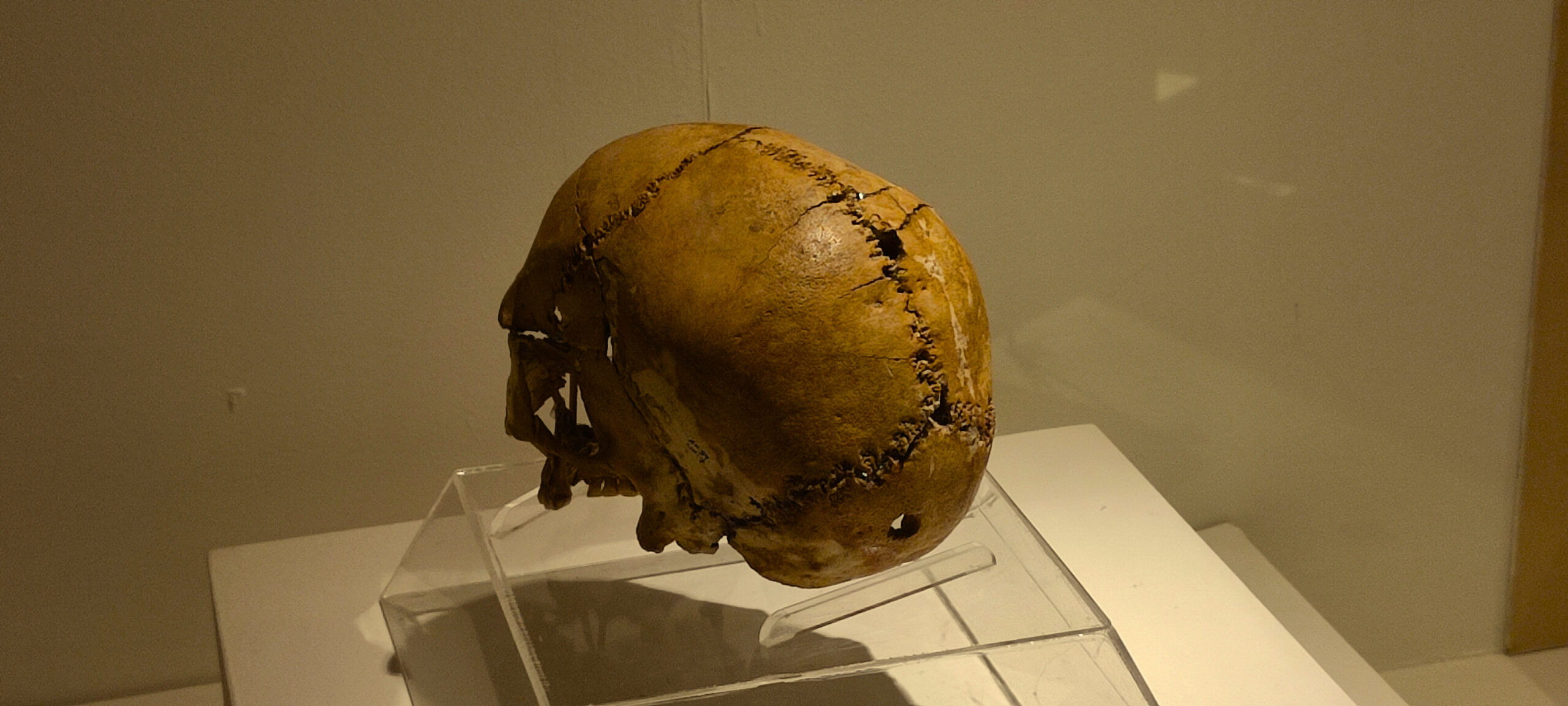
Some artifacts aren’t displayed — they wait. The skull from Aşıklı Höyük doesn’t lie in its case so much as it scans the room, choosing who dares to look back. Under the museum lights it feels less like a relic and more like a rebooted prototype of consciousness that once tried to understand the world through an obsidian incision.
You lean closer — and suddenly realize those two holes in the parietal bone look less like wounds and more like interfaces. As if someone, ten thousand years ago, attempted to open a port in the human mind for communication with something we still cannot name.
The silence thickens. The artifact says nothing, but its silence works like an API call: you understand that you’re here not only by the will of your own feet, but because a part of your mind has long been searching for answers not in words, but in voids.
Matter and Myth
Aşıklı Höyük is a Neolithic settlement older than many myths and almost all gods. People lived here before humanity realized it would one day have history. And one of these people — a young woman, 20–25 years old — stands before us now as a skull with two precise openings.
Trepanation. Brain surgery. Performed in the Neolithic age.
An operation done with obsidian — the sharpest blade of its era, volcanic glass capable of slicing flesh thinner than a modern surgical knife.
The traces on the bone say this was done during her lifetime. The bone had started to heal. The patient lived for about ten days after the procedure.
Someone who lived in a world without metal, without writing, without medicine as a discipline, managed to open a human skull without killing the person immediately.
An obsidian scalpel. A brain that didn’t yet know the word consciousness. And an attempt — desperate, deeply human — to fix something.
Science will say: “treating trauma, infection, pressure.” Myth will say: “they opened a path to release the evil or let the light in.” The skull says nothing. But it shows everything.
The Eye of the Past
Imagine: night over Aşıklı. Fires burn inside the long clay houses. The air smells of sheep’s wool and warm ash. Nearby, obsidian flakes crackle — they’re being prepared for the operation.
She lies on a reed mat. Her head aches so much the walls seem to drift. Or she’s been struck. Or she suffers from seizures that her people interpret as intrusions of the unknown.
Those around her don’t know the word medicine. But they know life. And they know death. And they try to keep the first away from the second.
Someone — a shaman, a surgeon, a stone-cutter, just a skilled hand — makes the first incision. Obsidian enters the skin like water. Blood shimmers in the firelight. The turbulence of pain races along the nerves.
When the bone opens, the world receives its first access to the human brain. She breathes. She holds on. She will fight for ten more days.
And that’s enough for us to stand before her skull ten thousand years later, trying to understand what truly happened.
Legacy in Dust
This skull is not just an artifact. It is proof that humans have always been willing to repair themselves — even before understanding what exactly they were repairing.
It’s not the first attempt at healing. Not the first fear. And not the first act of faith that the body can be fixed by hand.
Before you lies the witness of the moment when humanity first looked into itself literally. The first opened interface. The first manual access to the processor of the mind.
The irony: we still cannot explain our own brain, even though we’ve spent 10,000 years trying to get inside it.
The skull from Aşıklı is evolution’s bug report. A hardcore protocol of ancient healers. A reminder that we became ourselves not because we evolved cleanly, but because we kept trying, even when we had no idea what we were doing.
How Did We Get Here?
Today this artifact is held in the Aksaray Museum. It lies beneath glass, but the glass is a formality. Stand close enough and time itself seems to crack slightly, letting out the ancient air of Anatolia.
A visit requires no preparation — only the ability to look into the openings in the bone and not turn away from how fragile and stubborn our beginnings truly were.


Русская группа: Голос Руин https://www.facebook.com/share/g/1CLQsF8wob
Our Instagram: Voice Of Ruins https://www.instagram.com/voiceofruins/
Our Telegram-channel: Voice Of Ruins https://t.me/Voice_Of_Ruins
Our site: Voice Of Ruins https://www.voiceofruins.org




Leave a Reply