
Artifact of Inevitability
Through the Glass
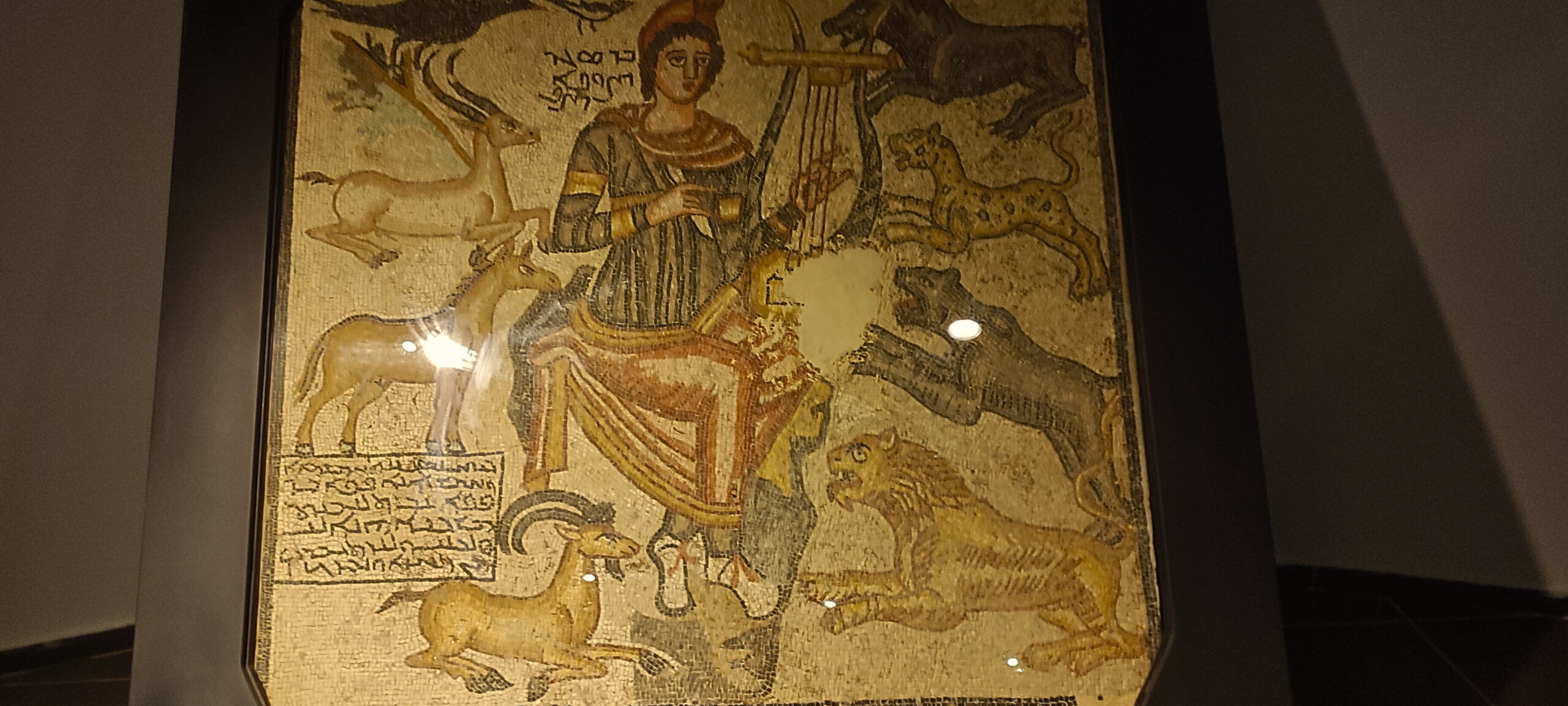
He is silent. Yet you can feel the music. On the floor — stone arranged into sound.
Orpheus sits with a kithara, surrounded by living yet motionless animals. A leopard. A deer. A boar. They seem to listen. They seem to remember.
The hall is quiet, but not empty. You stand before the mosaic. Tourists pass by with plastic headphones. A child reaches toward the barrier, freezes — and leaves.
Orpheus remains. He does not sing. But this — is the song.
Matter and Myth
A mosaic. Found on the floor of a Roman villa — most likely in a triclinium or a central hall where guests were received, conversations held, and people died of boredom or inspiration.
The image is executed in opus tessellatum technique — from tesserae, small cubes of stone and glass, laid with such precision that the lines of the body, the fur of the animals, and the strings of the kithara convey texture and movement.
Orpheus here is not a hero. He is an operator of myth.
He sits calmly, with a detached gaze. Around him — semi-wild nature, subdued not by force but by tonality.
The animals do not attack. They do not flee. They do not hunt.
They listen. And this can be heard.
The Eye of the Past
He was born in Thrace. Or in Boeotia. Or in the first music album.
He was the son of a Muse and a river spirit. Or the prototype of a singer before language began.
Orpheus is not merely a character. He is a mythological error in which sorrow is a function, not a bug.
He descended into Hades to retrieve Eurydice. He was allowed in because he sang. He was almost allowed out. But he turned back.
Since then, he sings without an addressee.
Later, his body was torn apart by maenads. His head was thrown into a river. But the lyre kept sounding.
What remained was not the voice, not the flesh, not the biography. What remained was a version for immortality.
A version without notes, but with gravitational meaning. A version where sound became a form of art.
Legacy in Dust
This mosaic is not an image of Orpheus. It is a frozen instruction for dealing with chaos.
The deer and goats, leopards and lions are not decoration. They are symbols of a world that submitted — briefly.
You look, and you understand: Orpheus did not tame the beasts. He simply set the right frequency.
Now his kithara is silent. But the form remains.
That is immortality: not continuation, but repeatability; not sound, but a structure waiting to be activated.
And everyone who looks at it activates it.
How Did We Get Here?
Today, this mosaic lies in the Mosaic Museum of Şanlıurfa, where the floor itself is silence.
The center of Şanlıurfa has long become a tourist territory — with museums, a necropolis, ruins, sacred pools, and selfies.
But the mosaic is not a tourist. It does not move. It does not leave. It does not respond.
The label reads: “Mosaic of Orpheus taming animals. 2nd–3rd century AD.”
But you already know it is not about that. This is not about Orpheus. This is about music the world no longer knows how to hear.
#VoiceOfRuins #ArtifactOfInevitability #Sanliurfa #Orpheus #Mosaic #RomanArt #Music #Myth #Silence #Power #Memory #Archaeology #History


Our Telegram-channel: Voice Of Ruins https://t.me/Voice_Of_Ruins
Our Instagram: Voice Of Ruins https://www.instagram.com/voiceofruins/
Our group on Facebook: Voice Of Ruins https://www.facebook.com/share/g/16aitn9utM/
Our site: Voice Of Ruins https://www.voiceofruins.org




Leave a Reply