
Dust of Ages
Entering the Labyrinth
Most cities are designed for life. Seleukeia Lyrbe was designed for its end.
You feel it immediately. Not through logic, not through facts — through the body. Space behaves differently here. It does not expand, does not invite, does not open. It contracts.
You enter the city — and instead of a sense of scale, you feel control. As if you have already been accounted for.
As if the architecture here does not serve people, but models their behavior in scenarios where everything has gone wrong.
Seleukeia Lyrbe is not the ruins of a city. It is the remains of a survival algorithm written in stone.
Past Empires
The city is located in Pisidia — a region where geography has always been stronger than politics. The Taurus Mountains here are not just terrain, but a system constraint.
Karst processes undermine stability: water disappears underground, springs are unreliable, soils are thin and fragmented.
Under such conditions, it is impossible to build a classical model of an ancient city — one based on excess infrastructure, export orientation, and dense economy.
So Lyrbe is built differently. The Hellenistic street grid here is not decorative — it is functional, like a navigation scheme in a complex environment. Straight lines are not aesthetics, but a way not to get lost.
The Roman period adds engineering discipline: drainage solutions, adaptation of buildings to slopes, control of water resources through cisterns and storage systems.
But the key is scale. The city does not grow exponentially. It is limited in advance. This is rare in antiquity, where growth is almost always the goal.
Lyrbe is a city with a built-in ceiling of development. The necropolis is the key to understanding it. It is not placed outside life. It is embedded within it as an equal layer of the system.
This is not a cult of the dead. It is the recognition that catastrophe is not an event, but a variable.
Fragments of the Present
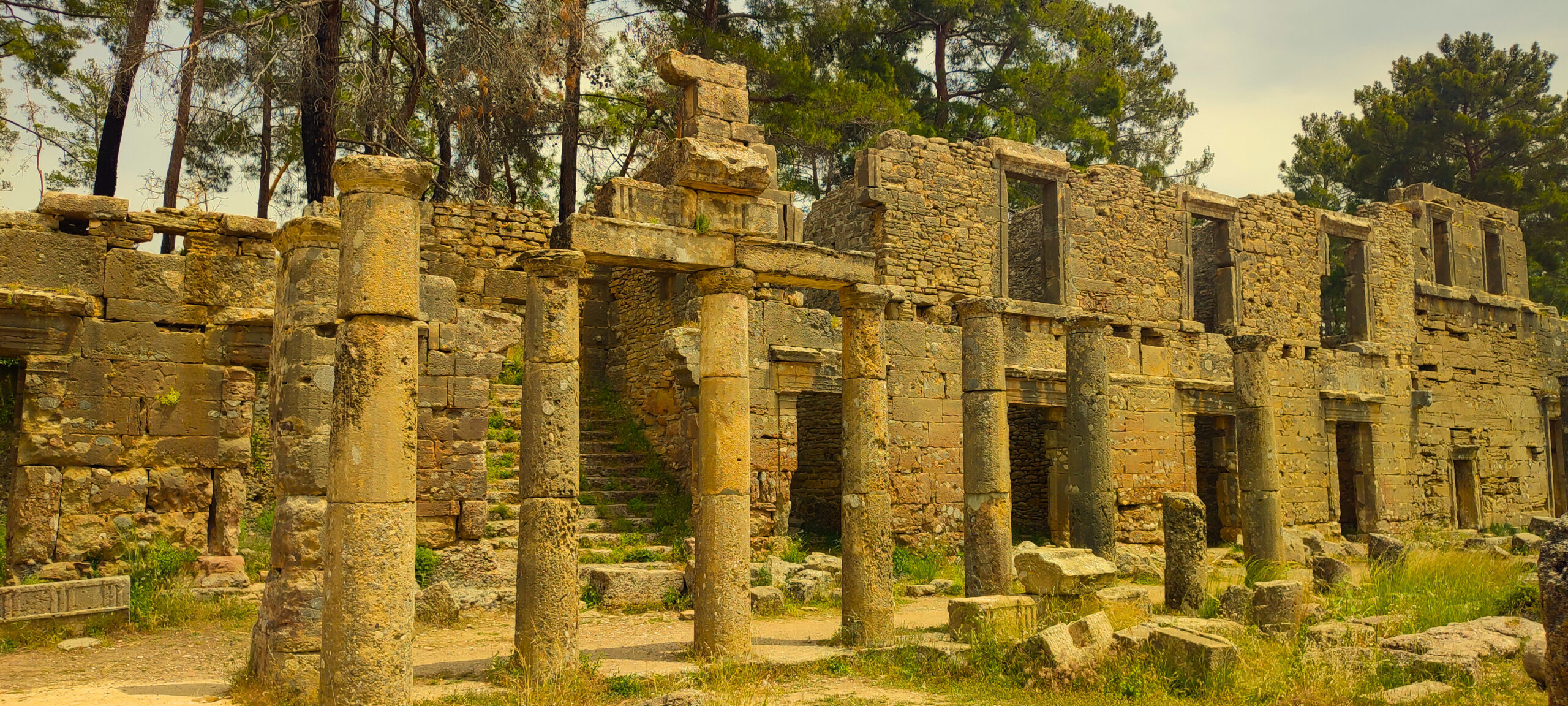
Today, Seleukeia Lyrbe looks like a perfectly preserved error. The city is not fully destroyed — and that is what makes it unsettling. Too much structure remains.
Colonnades read like a framework. Streets like lines of code. Stone blocks like modules assembled without tolerance for randomness. The forest has not destroyed the city. It has absorbed it without conflict.
This is crucial: Lyrbe is not struggling to survive. It has already adapted to disappearance.
Archaeologically, this is a paradox. Ruins are usually the result of destruction. Here, they are the result of cessation. No signs of total fire. No clear layer of catastrophic collapse. No markers of a sudden end.
The city feels as if it was simply switched off.
Shadows at the Edge of Reason
What if Lyrbe is not just a city, but a model? Not metaphorically, but literally: a spatial prototype of how a system behaves under pressure.
Every civilization eventually faces overload: resources, external threats, internal growth, entropy.
Most cities ignore this until the very end. Lyrbe accounts for it from the beginning.
It does not try to defeat chaos. It minimizes damage.
In modern terms, this means: rejection of excess, distributed resilience, reduced visibility, local autonomy.
But there is another layer. If space shapes behavior, then Lyrbe is a city that teaches how to disappear. Not metaphorically. Practically.
To compress. To simplify. To leave no unnecessary traces. To avoid becoming a target.
This is no longer urbanism. It is almost an ethics of survival.
How Did We Get Here?
To reach Lyrbe is to reproduce its logic.
You leave Manavgat or Side — spaces of hyper-accessibility. And gradually exit the system.
Roads narrow. Asphalt disappears. Connectivity becomes unstable. GPS loses confidence.
The final stretch is on foot. This is not just a lack of infrastructure. It is a filter.
Lyrbe is not protected by walls. It is protected by inconvenience of access. And that may be the most effective defense of all.
Echo in the Void
At some point, a thought appears that is hard to shake: what if most cities are a mistake, and Lyrbe is the correction?
We build bigger, brighter, denser. We accumulate functions, meanings, people. We complicate the system until it breaks.
Lyrbe does the opposite. It assumes from the beginning that everything will break. And it builds not a city, but a post-failure scenario.
You stand among the columns and suddenly understand: this city is not about the past. It is about what places look like when they outlive someone else’s future.
And that is why it is still here.
#VoiceOfRuins #DustOfAges #SeleukeiaLyrbe #Lyrbe #Pisidia #AncientCities #Archaeology #History #Geology #Karst #Urbanism #GhostCities #AncientCivilizations #RuinsOfTurkey #Antalya #Manavgat #Systems #Catastrophe #Survival #Decay #Eternity


Our Telegram-channel: Voice Of Ruins https://t.me/Voice_Of_Ruins
Our Instagram: Voice Of Ruins https://www.instagram.com/voiceofruins/
Our group on Facebook: Voice Of Ruins https://www.facebook.com/share/g/16aitn9utM/
Our site: Voice Of Ruins https://www.voiceofruins.org




Leave a Reply