
Dust of Time
Entrance into the Labyrinth
There are places that sense you before you manage to take the first step. The ancient city of Sobesos is one of them.
You step out of the car, inhale the dry Cappadocian air — and suddenly catch the feeling that an invisible scanner has swept over you. As if the city itself is checking your access, matching your patterns, comparing your inner noise with something ancient, long inscribed into the stone.
It’s eerily quiet here. Not tourism-related stillness — the silence of an algorithm that still runs but hasn’t received an update in centuries.
And you realize: the mosaic under your feet isn’t decoration. It’s an interface. It wasn’t designed for a user — and yet you’re already connected.
Past the Empires
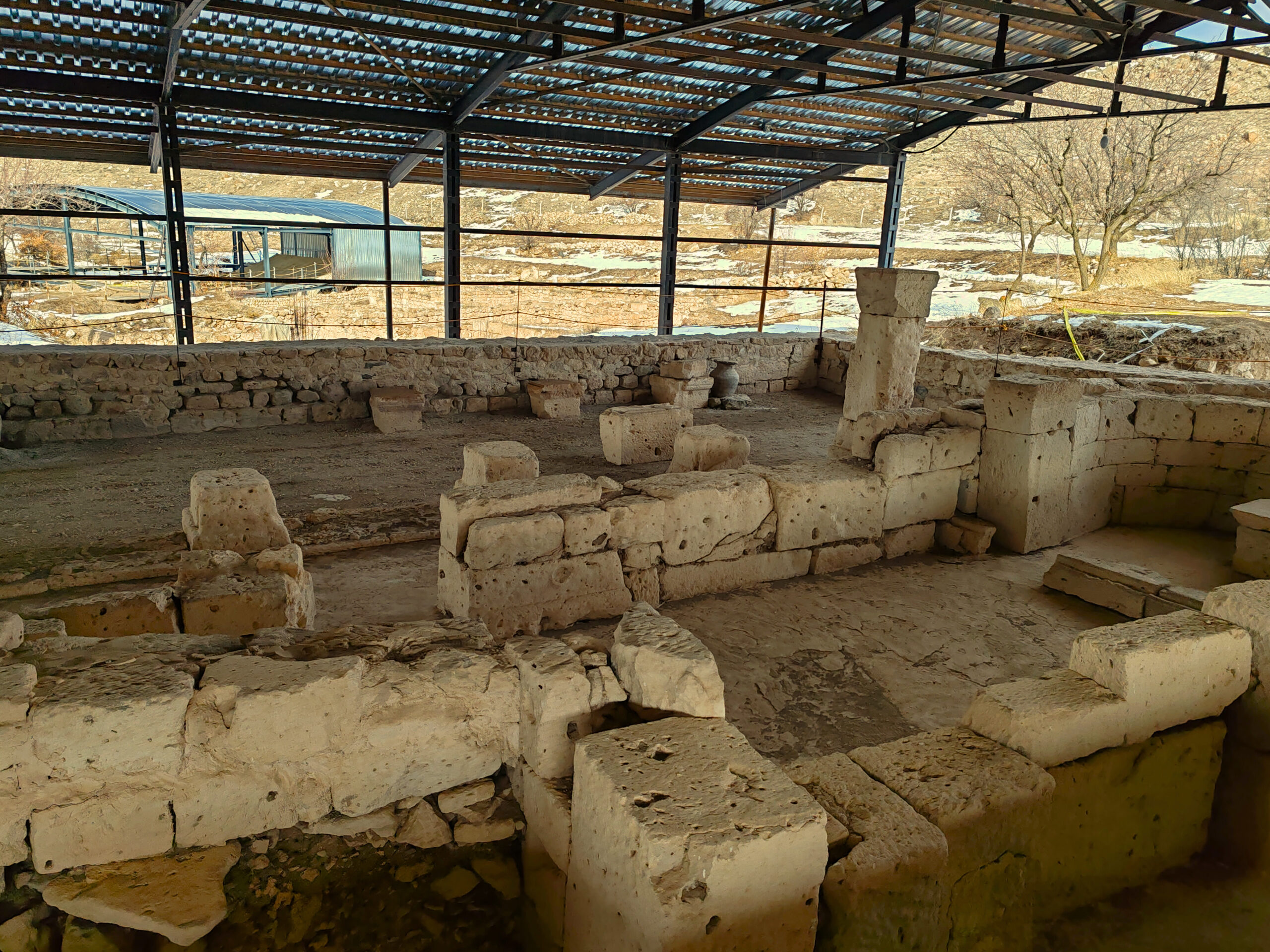
Sobesos is a small Late Roman city that was built — inexplicably — almost too beautifully for a provincial outpost. Mosaic halls, baths, a basilica, a necropolis — all part of a local miracle no one suspected until an excavator bucket hit geometry in the early 21st century.
They cut off a layer of earth — and it was like removing the lid of a server.
Inside — patterns: circles, squares, fragments of ornament assembled so economically and so precisely that it feels less like the work of an artist and more like someone who values logic above aesthetics.
The city emerged at a moment when the Roman Empire was already moving by inertia, and the provinces lived their own lives: strangely dense and quietly detached.
The geology around is soft sediment, volcanic dust, millions of years of tectonic meditation.
People built on this fragile ground almost defiantly — as if hoping art could hold time together when time began to collapse.
But time always collapses. The empire moved on. Sobesos remained, but it stopped speaking. And that silence — is the most intriguing part.
Fragments of Now
Today Sobesos is a neatly maintained archaeological site on the outskirts of Nevşehir, mentioned in most guidebooks only as an afterthought. And that somehow feels right: a place that stayed silent for so long shouldn’t raise its voice.
Here you find several rooms with perfectly readable mosaics. Exposed building outlines. Wall fragments that look as if they’re waiting.
Most striking are the clean lines: geometry so exact your brain starts subconsciously mapping it onto something familiar — pixels, grids, interfaces, early computing.
You walk among these patterns and feel that there is counting happening. Not for us, not about us — just counting. A system that’s still running simply because no one ever gave the shutdown command.
The excavations themselves look almost sterile — like an experimental module abandoned by its staff. Everything is calm, as if the city is in standby mode.
Shadows at the Edge of the Mind
You stand above the mosaic and catch the strange sensation of looking into a simplified model of the world. Every figure is not an image, but a formula. Every fragment is not a symbol, but an instruction.
Sobesos makes you wonder: what if the ancients weren’t merely decorating floors?
What if they were fixing the logic of perception — leaving behind algorithms meant to outlive them? Because digital traces fade, but stone is a limited form of immortality.
You feel it in your skin: the place is still working. Not for humans. Not for history.
For something deeper. For the structural memory of the world.
The thought comes on its own: maybe Sobesos isn’t a ruin at all, but an abandoned console. And the mosaics are the final code lines still compiling into the void.
And who knows what might happen if someone, someday, accidentally runs the whole sequence.
How We Got Here
Reaching the site is easier than expected:
Location: just a few minutes by car from Ürgüp and Nevşehir.
Transport: rental car or taxi; public transport comes here extremely rarely.
Time needed: 10–15 minutes if you’re a tourist; half an hour if you’re someone who knows how to listen.
Best time: early morning — the shadows fall at the angle where the patterns begin to behave as if they’re just a bit too alive.
Tips:
bring water — it’s open sun here;
come alone if you want to hear the city;
step lightly — Sobesos reacts to noise, even if that sounds like paranoid poetry.
Echo in the Void
When you return to the road, there’s a strange feeling that you’ve left something inside.
Not an object, not a thought — a tiny fragment of yourself the city accepted as one more element of its pattern.
Sobesos doesn’t try to charm you. It doesn’t tell a story — it makes you feel that history long ago turned into structure. And structure continues to count.
As you drive away, you look back — and it seems the mosaic watches your back. Not as art. As a process.
And you understand that some part of that process is now running inside you.
#VoiceOfRuins #DustOfTime #Sobesos #Cappadocia #Turkey #Archaeology #LateRome #Mosaics #Ruins #AncientCities #History #Travel #Geology #MysticalPlaces #Antiquity


Our Telegram-channel: Voice Of Ruins https://t.me/Voice_Of_Ruins
Our Instagram: Voice Of Ruins https://www.instagram.com/voiceofruins/
Our group on Facebook: Voice Of Ruins https://www.facebook.com/share/g/16aitn9utM/
Our site: Voice Of Ruins https://www.voiceofruins.org




Leave a Reply