
Dust of Time
Entering the Labyrinth
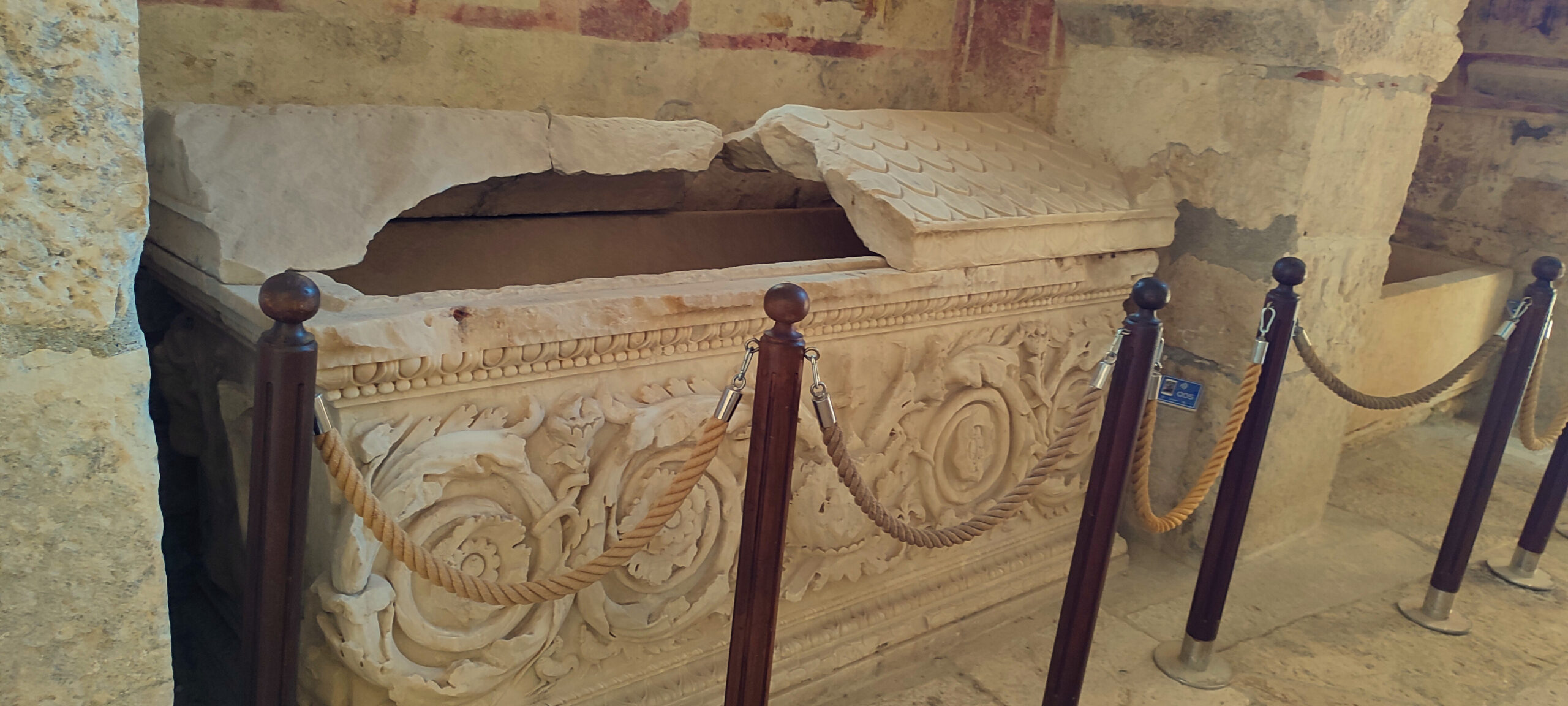
At the center of the Church of St. Nicholas in Demre stands a sarcophagus. It is made of stone, heavy, carefully crafted and , of course, absolutely empty.
This is not a metaphor. It is definitely a fact.
You look inside — and you do not see the saint. You look longer and then begin to realize that emptiness itself is the main exhibit here. Not loss, not theft, not historical injustice, but an architecturally fixed absence.
The church is built around what is no longer there.
Past the Empires
Nicholas of Myra died in the 4th century. He was buried in Myra of Lycia — a city that at the time had no idea it would become a hub of pilgrimage, relic trade, and ideological influence.
The first grave was modest. Later, a basilica was erected above it. Then — a more complex church complex.
Archaeology records several construction phases:
— an early Byzantine basilica;
— reconstructions after the earthquakes of the 6th–7th centuries;
— fortifications and changes during the period of Arab raids;
— the final Byzantine configuration of the 11th century.
Each stage was an attempt to preserve a point. Not a building. Not a style. But a coordinate.
In 1087, the relics of Nicholas were taken to Bari. Partly through diplomacy. Partly by force. Sources argue, but the result is the same: the sarcophagus in Demre became empty.
Fragments of the Present
Today, the sarcophagus is open. Tourists peer inside. Some of them can take photographs. Some cross themselves. A little bit experience a strange disappointment — as if they had been deceived.
But archaeology does not know the word “deception.” It knows the word context.
Around the sarcophagus, fragments of mosaics with geometric and vegetal motifs have been found. The frescoes are late, repeatedly renewed, with remnants of scenes from the saint’s life. The floor lies below the modern ground level due to silting from the Myros River.
The sarcophagus itself is typical of the Late Antique Eastern Mediterranean, with local Lycian features in stone carving. It was never decorative. It was functional.
And now it performs a different function.
Shadows at the Edge of Reason
An empty sarcophagus is a dangerous thing. It lacks finality. If the saint is here — everything is clear. If the saint is absent then thinking begins.
The Church of St. Nicholas is a rare case in which the cult did not collapse after the loss of the relic. It switched modes. Presence ceased to be bodily. It became spatial.
The saint is no longer in the stone — he is in the route, in the acoustics, in the way footsteps echo off the walls. In the fact that the church did not empty along with the sarcophagus.
Mysticism here is not in miracles. It is in the fact that emptiness continues to function as an anchor of meaning.
How Did We End Up Here?
At this time the church stands in the center of modern Demre. It is easy to reach on foot, but difficult to enter correctly.
It is best to come during hours of minimal flow. Do not rush to the sarcophagus. Firstly – walk the space.
Notice the traces of water on the walls. The unevenness of the floor. The marks of restorations that do not hide scars, but record them.
This is not a church for a quick visit of course. It is also a place where it is important to stay.
Echo in the Void
When you leave the Church of St. Nicholas, the emptiness of the sarcophagus goes with you. Not as a loss. As a form.
You understand that the saint is not where the body lies. He is where the system continues to function without it.
Empires carry away relics. Rivers silt up cities. Earthquakes obviously erase plans.
And the empty sarcophagus remains — as a reminder that sometimes absence speaks louder than presence.
#VoiceOfRuins #DustOfTime #Demre #Myra #SaintNicholas #ChurchOfSaintNicholas #EmptySarcophagus #Lycia #Byzantium #archaeology #ruins #relics #holiness #presence #memory


Our Telegram-channel: Voice Of Ruins https://t.me/Voice_Of_Ruins
Our Instagram: Voice Of Ruins https://www.instagram.com/voiceofruins/
Group on Facebook: Voice Of Ruins https://www.facebook.com/share/g/16aitn9utM/
Our site: Voice Of Ruins https://www.voiceofruins.org




Leave a Reply