
Dust of Ages
Entrance into the Labyrinth
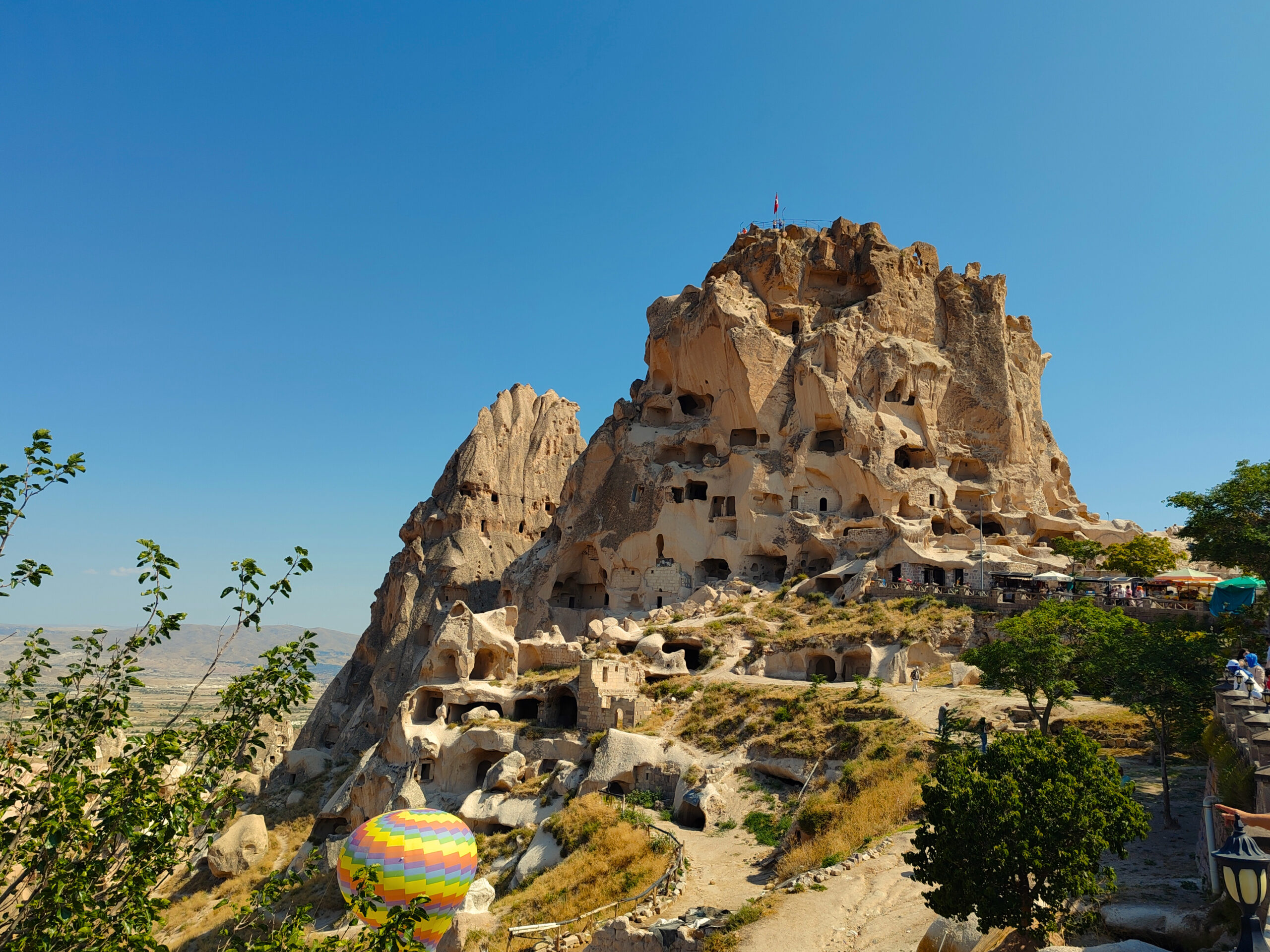
There are places where geography behaves like an artificial intelligence on the brink of self-awareness. Where the landscape doesn’t just show altitude—it tests you, checking how much excess you’re willing to carry in your mind before you climb higher. Uçhisar is one of those places. A rock that pretended to be a fortress and then forgot it was pretending. It rises above Cappadocia like a cursor over a blank screen: blinking, waiting, inviting you to type your own version of reality into it.
As you approach, you don’t feel the height—you feel that something has been watching you from above for a very long time. And the closer you get, the more certain you become: it’s not a human watching. And not a god. It’s emptiness itself.
Past the Empires
Uçhisar wasn’t born in an era—it was born in a process. Volcanic eruptions, tuff, magma, explosions, ash, millions of years of geological refining—everything came together to shape the rock as if the ancient world decided to grow its own memory server.
People came later. Hittites, Persians, Romans, Byzantines, Seljuks—each left its marks in the fortress like clumsy commits in a repository no one controls anymore. Inside its body are hundreds of rooms, caves, passages, secret tunnels. Once they served as shelter, as lookout, as the illusion that the world could be controlled from above.
But the world is not controlled. It anneals itself like an old matrix: parts vanish, others emerge, and only the rock remains. Uçhisar didn’t defeat empires—it outwaited them.
Shards of Now
Today Uçhisar is a vertical anthill of memory, besieged by tourists with the same persistence with which ancient residents carved its chambers. The rocky tower gazes over Cappadocian valleys where the air vibrates with hot-air balloons, paragliders, and drones—like with scattered thoughts drifting past.
The fortress protects no one anymore—it simply exists. And it does that better than most. The path to the top now has a ticket price, but the summit remains free in its indifference. Winds blow as if trying to slip into your head and reformat your memory. On the horizon lie Göreme, Avanos, Ortahisar. Everything looks quiet, but not dead. The world here simply operates on another frequency.
Shadows at the Edge of the Mind
Standing atop Uçhisar, you realize: emptiness is not absence. It is presence of another kind. What we call “silence” here sounds louder than any wind.
You get the sense that someone once used Uçhisar as an antenna to communicate with something beyond the human. Not necessarily gods—gods we invented so we wouldn’t lose our minds. Something more like the architecture of reality itself. The rock isn’t stone—it’s an interface. A place where matter pretends to be solid and consciousness pretends to be autonomous.
From the summit you see how the Earth drifts through time, slowly and indifferently. And you realize that perhaps the whole meaning of humanity is to be noticeable from an angle where at least something might look back at us.
How Did We Get Here
Getting to Uçhisar is easy—which in itself feels suspicious. Buses, dolmuşes, taxis from Göreme and Nevşehir, roads polished by tourist flow. The climb to the fortress is simple, though your body insists it’s ascending Mars. Tickets are sold at the entrance. It’s best to come early in the morning or at sunset—those are the hours when Cappadocia opens like an old file suddenly revealed to contain hidden pages.
Wear comfortable shoes. Expect strong wind. There are no shelters at the summit: you can only stand exposed—or not at all. In winter it’s cold, in summer dry. Bring water, but be ready for the strange feeling that at this height it feels less real than the rock itself.
Echo in the Void
As you descend back into the village, it feels as though Uçhisar keeps looking at the back of your head. Not threateningly—more like wondering what you’re going to do now with your updated data.
Uçhisar has a strange property: it explains nothing, yet makes you feel like you’ve understood something. And when you leave, the world seems slightly less sure of itself—and slightly more honest.
The Lighthouse of Emptiness over Cappadocia doesn’t shine outward—it shines inward. And if you’ve climbed it even once, the light stays.
#VoiceOfRuins, #DustOfAges, #Uçhisar, #Cappadocia, #fortresses, #archaeology, #geology, #ruins, #travel, #tuff, #AncientCities


Our Telegram-channel: Voice Of Ruins https://t.me/Voice_Of_Ruins
Our Instagram: Voice Of Ruins https://www.instagram.com/voiceofruins/
Our group on Facebook: Voice Of Ruins https://www.facebook.com/share/g/16aitn9utM/
Our site: Voice Of Ruins https://www.voiceofruins.org




Leave a Reply