
Call of the Void
Point of Disappearance
This place has a very simple structure—and that’s exactly why it works. There is a collapse. There is an edge. And there is a human standing between them, trying to come up with an explanation.
Cennet ve Cehennem are karst sinkholes formed not by a sudden catastrophe, but by a slow process: water dissolved the limestone, cavities formed underground, and eventually the surface gave way.
But when you stand at the edge of “Heaven” (Cennet), geology becomes irrelevant. Because what you see is not a process, but a result: a massive hole in the world that has no human logic.
And directly above this collapse—there is a temple.
Landscapes Without Hope
The road here runs through the dry, rigid terrain of Mersin Province. Stone, shrubs, occasional wind. No “drama”—until you reach the edge.
“Heaven” is a wide sinkhole, about 250 meters in diameter and up to 70–80 meters deep. A staircase leads down. You can see the bottom, you understand the scale, you can descend into it.
Nearby is “Hell” (Cehennem). Narrower, deeper, with almost vertical walls. No staircase. No access.
The difference between them is not size. The difference is permission.
One allows human presence. The other does not.
And that is no longer geology. That is a condition you do not control.
The Cry of Stone
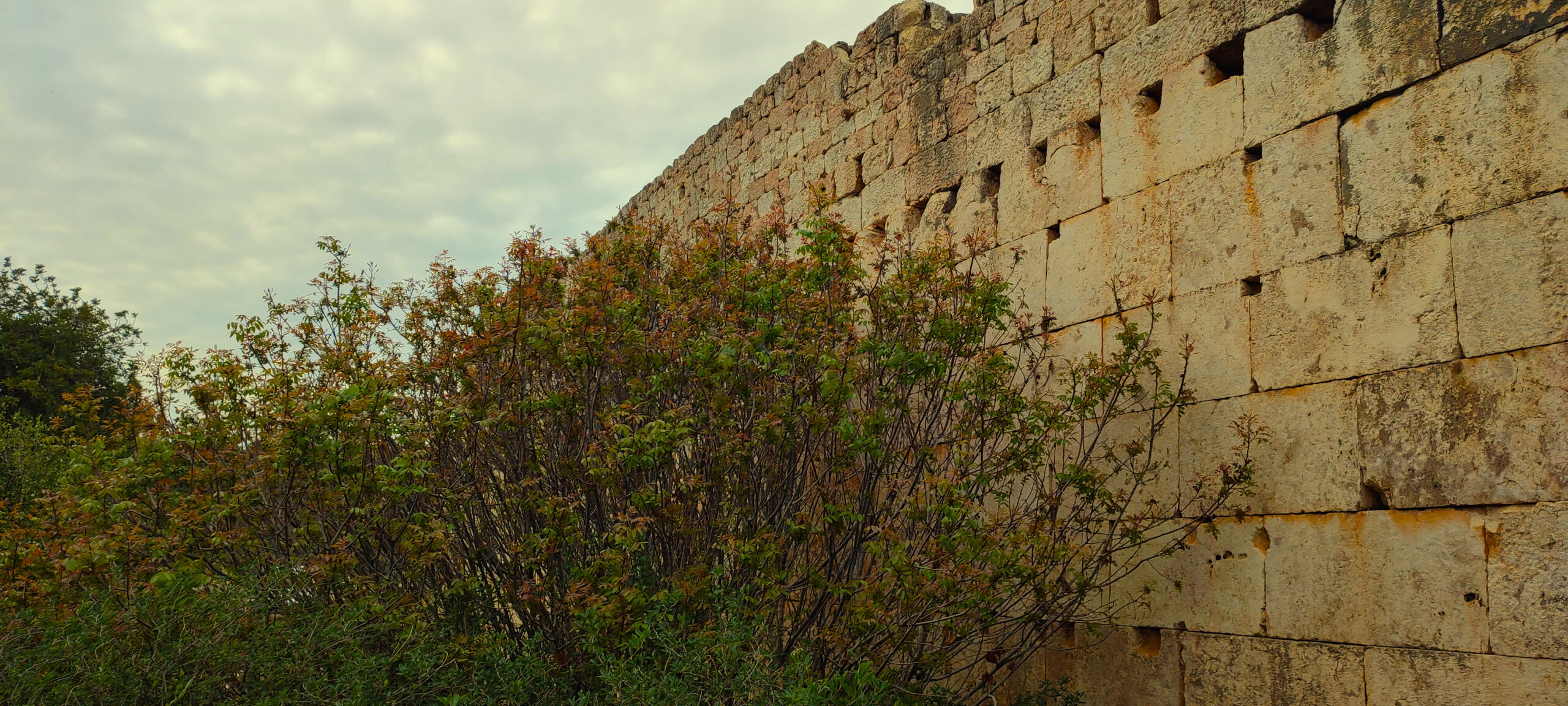
The Temple of Zeus is located at the top, right on the edge of the “Heaven” sinkhole. Not below, not along the descent—exactly on the fracture line of the surface.
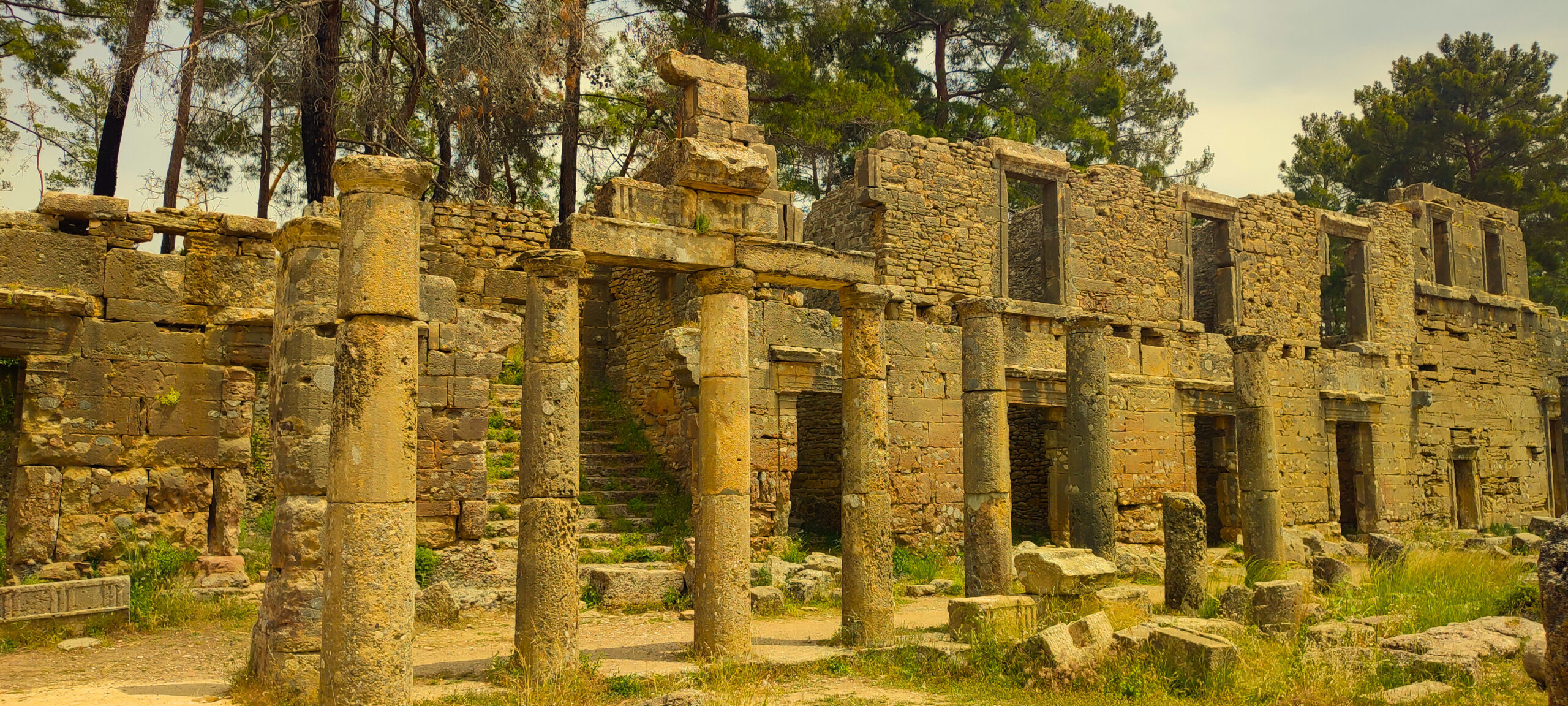
It dates to the 2nd century CE, the Roman period. Today, only fragments remain—foundations, broken columns, traces of layout. But its position matters more than its condition. It is a point from which one looks down.
It was dedicated to Zeus—and that makes sense. Not because he is the “chief god,” but because this is a place that requires someone responsible for order where order does not exist.
Now—the second part of the structure.
If you descend into “Heaven,” after roughly 450 steps you reach the bottom, inside the sinkhole. And there, against the rock, stands an early Christian church (Byzantine period, around the 5th century).
So: above—a temple of Zeus. Below—a Christian church.
One point is above the void. The other is inside it.
This is not accidental. It is two different strategies. Antiquity tries to hold the boundary. Christianity works with the interior of the collapse.
Shadows at the Edge of Reason
This place has a specific mythological anchor.
It was believed that this is where Zeus fought Typhon.
Typhon is not a “monster” in the usual sense. He is described as a being of fire, wind, serpents, and chaos—a force that does not just threaten the world, but breaks its structure.
In the myth, Zeus defeats him and seals him beneath the earth.
Now look at the landscape without poetry:
there is a collapse,
there is an inaccessible depth nearby,
there is a temple above.
The myth is not decoration. It is a way of saying: “we know something is down there, and it must remain there.”
In this sense, the temple is not a place of prayer. It is a marker of control.
But “Hell” is nearby—and it cannot be entered. And that breaks the entire system.
Because if there is a place you cannot reach, then that is the place that matters most.
Traces on the Map
The complex is located near Silifke.
Facts:
— “Heaven” (Cennet): a large sinkhole, accessible by a staircase (~450 steps)
— “Hell” (Cehennem): narrower, deeper, inaccessible
— Temple of Zeus: 2nd century CE, located above, at the edge of “Heaven”
— Church below: Byzantine period, inside the sinkhole
— Geology: karst processes (limestone dissolution)
Getting here is easy. Leaving is harder—not physically, but mentally. The best time is when there are no people. Because with people, it is a site. Without them, it becomes a system.
Echo in the Void
After this place, a very simple scheme remains—one that is hard to ignore:
above—a system trying to maintain control,
below—a system trying to comprehend depth,
between them—a void that obeys neither.
And the most unsettling part is the feeling that the void is primary. Everything else is just a layer built over it.
The Temple of Zeus stands above the collapse not because it is beautiful there, but because that is where a point had to be placed. And it is still not closed.
#VoiceOfRuins #CallOfTheVoid #CennetveCehennem #TempleOfZeus #Typhon #Mersin #Silifke #Karst #Antiquity #Byzantium #Underworld #Ruins #MysticPlaces #Turkey


Our Telegram-channel: Voice Of Ruins https://t.me/Voice_Of_Ruins
Our Instagram: Voice Of Ruins https://www.instagram.com/voiceofruins/
Our group on Facebook: Voice Of Ruins https://www.facebook.com/share/g/16aitn9utM/
Our site: Voice Of Ruins https://www.voiceofruins.org



Leave a Reply